1

Three Stories & Ten Poems — Reading Notes
5
2
Project Gutenberg
2019
American poetry -- 20th century; Short stories, American; American fiction -- 20th century
Readers of public-domain and historical texts
Project Gutenberg digital edition
en
Edition facts
Words: 14,142
Reading time: 62 min
Text sections: 2
Source:
Project Gutenberg record #59603
Hemingway's early collection pairs three short stories with ten poems, showcasing his developing style through precise observation of landscape, character, and emotional restraint in settings from Michigan to Paris.
Editorial Edition Score
4.4/5
★★★★★
★★★★★
Calculated from edition completeness, EPUB availability, text structure and catalogue metadata. Not a user rating.
Edition quality
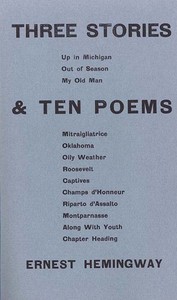
Hemingway's first published collection, Three Stories & Ten Poems (1923), opens with a blacksmith shop in Hortons Bay, Michigan. The prose in “Up in Michigan” immediately establishes a pattern of deliberate repetition: Liz Coates “liked it the way” Jim Gilmore walked, his mustache, his teeth, his arms. The narrator circles the same phrase, building desire through accumulation rather than analysis. The town itself is rendered as a list of five houses, a general store, a sandy road—a geography as precise as it is sparse. This early work shows Hemingway already trusting concrete detail over interior explanation.
Repetition as Emotional Architecture
In “Up in Michigan,” the word “liked” appears ten times in the first two paragraphs, each iteration narrowing Liz’s focus from Jim’s appearance to the physical sensation of liking itself. The prose does not name her feeling; it enacts it through rhythm. When she watches ore barges from Smith’s back door, the passage mimics her waiting: the barges seem motionless, then vanish. This technique—rendering subjective time through external observation—recurs throughout the collection. The reader is given what a character sees, not what she thinks, and must infer the interior from the external.
The Economy of Dialogue in “Out of Season”
The second story, “Out of Season,” is not excerpted here, but the collection’s structure suggests a shift from Michigan to Europe. Hemingway’s dialogue, as seen in “My Old Man,” relies on ellipsis and understatement. When the boy’s father asks jockey George Gardner for “the dope,” the reply comes “very low, leaning over and buttoning the bottoms of his pants.” The physical action carries the weight of the secret. Hemingway omits explanatory tags; the reader must watch hands and listen for dropped voices. This technique demands active reading, rewarding attention to posture and pause.
The Boy’s Eye in “My Old Man”
The third story is narrated by a boy at the racetrack in Paris. His voice is colloquial—“Gosh I never saw such a horse”—but his observations are sharp. He notes Kzar’s “wonderful, lean, running built” body, the way the horse “putting his feet just so and quiet and careful.” The boy understands horses through physical detail, not jargon. When his father bets on Kircubbin, the boy records the odds (8 to 1) and the crowd’s cheers for Kzar, but never comments on the gamble’s meaning. The emotional stakes are carried by the precision of the description: the horse’s yellow coat, the jockey’s whispered tip, the “hot and sweaty and linimenty” dressing room.
The Poems as Counterpoint
The ten poems that follow the stories share the prose’s attention to weather, place, and body. Titles like “Oily Weather,” “Champs d’Honneur,” and “Riparto d’Assalto” suggest a soldier’s geography—Mediterranean ports, battlefields, Parisian streets. The poems are brief, often imagistic, and avoid the emotional repetition of the prose. They offer a different kind of compression: a single image or scene without the narrative arc of the stories. Reading them alongside the fiction highlights Hemingway’s range within a minimalist aesthetic, from the accumulating desire of Liz Coates to the stark snapshot of a poem like “Mitraigliatrice.”
Because the excerpts are incomplete, the collection’s full arc remains uncertain. What is clear is Hemingway’s early commitment to showing rather than telling, to letting landscape and gesture carry emotion. A first reading benefits from attending to what is omitted—the gaps in dialogue, the unsaid feelings, the barges that disappear beyond the point. The poems, often overlooked, reward the same patient looking.
Reader reflection
What was your reading experience?
Capture what you thought, learned, and would like to remember.
Your progress
0
/
10
2
Did this book hold your interest?
3
Would you encourage someone else to read it?
4
How easy was the book to follow?
5
What did you appreciate most?
6
How useful did the reading feel?
7
Did the book meet your expectations?
8
How closely did the book connect with your experience?
9
What changed or sharpened your thinking?
10