1

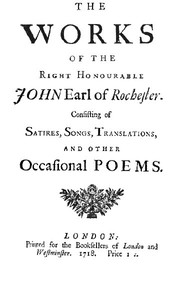
The Works of the Right Honourable John, Earl of Rochester Consisting of Satires, Songs, Translations, and other Occasional Poems — Reading Notes
4
0
Project Gutenberg
2014
English poetry -- Early modern, 1500-1700; Occasional verse -- Early works to 1800; Satire, English -- Early works to 1800
Readers of public-domain and historical texts
Project Gutenberg digital edition
en
Edition facts
Words: 15,860
Reading time: 69 min
Text sections: 3
Source:
Project Gutenberg record #44891
This edition of Rochester's poems reveals his satirical voice through diction, dialogue, and description, as seen in 'A Satire against Mankind,' 'The Maim'd Debauchee,' and 'Upon Nothing.' The author's choice of metaphors, rhetorical structures, and tonal shifts creates a distinctive blend of cynicism and wit.
Editorial Edition Score
4.5/5
★★★★★
★★★★★
Calculated from edition completeness, EPUB availability, text structure and catalogue metadata. Not a user rating.
Edition quality
Rochester's verse in this 1718 collection is marked by a deliberate roughness of diction and a confrontational stance toward reason and social norms. In 'A Satire against Mankind,' he calls reason an 'Ignis Fatuus of the Mind' and prefers instinct, using extended metaphors of drowning and stumbling to undermine intellectual pride. The speaker's voice is both self-mocking and defiant, a pattern that recurs across the poems.
The collection's structure—mixing satires, songs, and translations—highlights Rochester's range, but his authorial choices in dialogue and description consistently favor vivid, often violent imagery over abstract argument. Even in lighter pieces, such as 'The Maim'd Debauchee,' the language retains a martial edge, comparing debauchery to naval warfare.
Reason as a False Guide
In 'A Satire against Mankind,' Rochester builds his critique on a series of concrete images that depict reason as treacherous. He describes it as a 'Will-o'-the-wisp' leading the 'misguided Follower' through 'Error's fenny Boggs, and thorny Brakes.' The sensory details—bogs, brakes, climbing, stumbling—make the abstract argument tangible. The speaker's choice to prefer instinct over reason is not merely philosophical but grounded in a physical sense of danger and exhaustion.
Rochester's diction reinforces this: 'Huddled in Dirt the reas'ning Engine lies' reduces human intellect to a mechanical object, dirty and broken. The word 'Engine' strips dignity from the rational mind, while 'Huddled' suggests carelessness and decay. This pattern of using concrete, often degrading terms for mental faculties recurs throughout the satire, making the critique visceral rather than abstract.
The Voice of the Impaired Speaker
'The Maim'd Debauchee' employs a striking structural choice: the speaker compares himself to a 'brave Admiral in former War' who, though 'Depriv'd of Force,' still feels 'Courage.' The simile extends over several stanzas, with the admiral 'Crawls to the Top of an adjacent Hill' to watch a battle he cannot join. This physical limitation mirrors the speaker's own 'Days of Impotence' due to 'Love and Wine's unlucky Chance.'
Rochester's dialogue here is internal and retrospective. The speaker's 'Pains' grant him 'Respite' to observe others' 'Battels,' but his advice is laced with irony: he will 'fire his Blood by telling what I did, / When I was strong.' The tone mixes boastfulness with self-awareness, and the final line—'being good for nothing else be wise'—undercuts any pretense of genuine wisdom. The authorial choice to frame debauchery as a lost physical prowess gives the poem a melancholic edge beneath its bravado.
Nothing as a Personified Origin
'Upon Nothing' opens with a bold personification: 'Nothing! thou elder Brother ev'n to Shade, / Thou hadst a Being e'er the World was made.' Rochester grants 'Nothing' a paradoxical existence, older than creation itself. The diction is playful yet precise: 'elder Brother' suggests familial hierarchy, while 'well fix'd' implies stability. The poem's structure—three-line stanzas with a closing alexandrine—creates a rhythmic emphasis on the final, often paradoxical line.
The description of creation as 'primitive Nothing something straight begot' uses a pun on 'begot' to imply sexual generation from void. Rochester's choice to treat 'Nothing' as an active principle allows him to satirize philosophical and theological origins. The line 'Then all proceeded from the great united—What' breaks off with a dash, leaving the reader to fill the blank—a rhetorical trick that mirrors the poem's theme of absence and presence.
Tonal Shifts and Self-Presentation
Across the collection, Rochester's authorial voice shifts between aggressive satire and lyrical intimacy. In 'A Satire against Mankind,' the speaker declares, 'Born to my self, I like my self alone,' a line that combines arrogance with isolation. The diction is blunt: 'I like my self alone' uses monosyllables for emphasis. Yet in the songs, such as 'The Mistress' or 'Love and Life,' the tone becomes softer, with regular meter and conventional romantic imagery.
This contrast is a deliberate authorial choice. The satires employ rough, colloquial language and irregular rhythms, while the songs adhere to smoother forms. Rochester's dialogue in the satires often mimics argumentative speech, with rhetorical questions and exclamations ('Why then the World shall suffer for't, not I'). In the songs, the voice is more lyrical and introspective. The juxtaposition within a single volume suggests a poet deliberately playing with personae, never fully committing to one stance.
Readers approaching this edition should attend to the interplay between Rochester's satirical and lyrical modes. The poems reward attention to his specific word choices—how he uses physical imagery to embody abstract ideas, and how his speakers' voices shift between defiance and vulnerability. The incomplete excerpts leave the full arc of the collection unclear, but the patterns visible in these poems offer a rich starting point for exploring Rochester's craft.
Reader reflection
Before you leave, reflect on the book
Use these questions to collect your thoughts before moving on.
Your progress
0
/
10
2
Did this book hold your interest?
3
How likely are you to recommend this book?
4
What was the reading difficulty like?
5
How distinctive were its ideas or approach?
6
Did the book give you something worth debating?
7
Did the book deliver what you hoped for?
8
What was its emotional impact?
9
What is the main idea you are taking away?
10