1

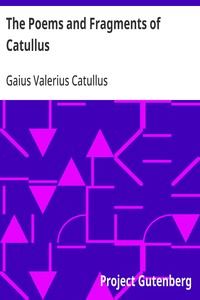
The Poems and Fragments of Catullus Translated in the Metres of the Original — Inside the Classic
990
2
Project Gutenberg
2006
Rome -- Poetry; Catullus, Gaius Valerius -- Translations into English; Love poetry, Latin -- Translations into English; Epigrams, Latin -- Translations into English
Readers of public-domain and historical texts
Project Gutenberg digital edition
en
Edition facts
Words: 27,452
Reading time: 120 min
Text sections: 6
Source:
Project Gutenberg record #18867
Robinson Ellis's 1871 translation of Catullus into English, preserving the original Latin metres and quantitative verse, with a preface detailing his method and a sample of his rendering of Catullus 64, the epyllion on Peleus and Thetis.
Editorial Edition Score
4.6/5
★★★★★
★★★★★
Calculated from edition completeness, EPUB availability, text structure and catalogue metadata. Not a user rating.
Edition quality
Robinson Ellis's 1871 translation of Catullus aims to reproduce not only the ancient metres but also the ancient quantity—a principle he distinguishes from the accentual approach of Longfellow or Clough. In his preface, Ellis explains that he was inspired by Tennyson's Alcaics and Hendecasyllables and by Theodor Heyse's German version. He critiques earlier English experiments for neglecting 'position,' the lengthening of a syllable by a following consonant, and offers his own quantitative hexameters as a corrective. The excerpts include a substantial portion of Catullus 64, the epyllion on Peleus and Thetis, rendered in Ellis's hexameters, showing his method in practice.
Metrical Principles and Prefatory Argument
Ellis opens his preface by recounting his early, unsuccessful attempts at translating Catullus in original metres, modelled on Heyse. He then describes a turning point: Tennyson's classical metres suggested 'the new principle on which I was to go to work.' Ellis insists that reproducing ancient metres is insufficient unless 'the ancient quantity was reproduced also.' He contrasts his approach with that of Longfellow's Evangeline and Clough's Bothie, which he says 'almost invariably disregarded position.' He also notes that Swinburne, while artistically successful, 'neglects position as a rule.' Ellis's own hexameters, he claims, find their nearest approach in Kingsley's Andromeda, which he calls 'a step to what may fairly be called a new development of the metre.' The preface thus functions as a manifesto for quantitative verse in English.
The Epyllion as Structural Centerpiece
The longest excerpt is from Catullus 64, a miniature epic on the marriage of Peleus and Thetis. Ellis's translation renders the poem's elaborate similes and ekphrastic descriptions. For instance, the simile of the oak on Taurus: 'As on Taurus aloft some oak agitatedly waving / Tosses his arms, or a pine cone-mantled, oozily rinded.' The passage also includes Ariadne's lament on Dia, where she addresses Theseus: 'Look, is it here, false heart, that rapt from country, from altar, / Household altar ashore, I wander, falsely deserted?' The translation preserves the poem's alternation between narrative and direct speech, and its movement from the wedding scene to the embedded story of Theseus and Ariadne. Ellis's hexameters attempt to mirror the Latin's weight and pace, with enjambments and compound epithets like 'heart-hungry' and 'traitorous-hearted.'
Recurring Images: Sea, Wind, and Abandonment
Throughout the excerpt from Catullus 64, images of the sea and wind recur, often in contexts of separation or loss. Ariadne's ship is 'on a shore of foaming Dia'; she 'ran forth, upsplashing freshly to meet her, / Lifting raiment fine her thighs which softly did open.' Theseus's promises are 'melted in air, with a light wind emptily fleeting.' The simile of the oak on Taurus, 'when as his huge gnarled trunk in furious eddies a whirlwind / Riving wresteth amain,' links natural force to Theseus's violence. The translation also uses 'billows wearily tossing' to describe the lovers' turmoil. These images create a consistent sensory texture: the physicality of wind and water mirrors emotional states, from Ariadne's 'frenzied fantasy burning' to the 'chill sobs' that 'gushed dolorous ever.'
Movement Between Scenes and Speakers
The excerpt from Catullus 64 shifts rapidly between narrative frames. It opens with Theseus's journey to Crete, then moves to the 'royal virgin' Ariadne gazing on him, then to the battle with the Minotaur, then to the labyrinth and the thread, then to Theseus's desertion on Dia, and finally to Ariadne's long speech. Ellis marks these transitions with phrases like 'Yet, for again I come to the former story, beseems not / Linger on all done there.' The translation also includes a gnomic aside: 'Let not a woman trust, since that first treason, a lover's / Desperate oath.' This movement between action, description, and direct speech is characteristic of Catullus's epyllion, and Ellis's version preserves the shifts in register—from the epic simile of the oak to the intimate cry of Ariadne's lament.
Ellis's translation invites attention to the interplay between metrical form and poetic content. Readers interested in the history of English classical verse may compare his quantitative hexameters with those of Kingsley or with the accentual experiments of the Elizabethans. The preface provides a clear statement of his aims, while the rendering of Catullus 64 offers a sustained example of his method in action. For those encountering Catullus through this edition, the translation rewards close reading of its rhythmic choices and its handling of the Latin's imagery and structure.
Reader reflection
Record your reading impressions
A brief reflection can help important ideas stay with you longer.
Your progress
0
/
10
2
How did the book work for you overall?
3
Would you pass this book on to a friend?
4
How easy was the book to follow?
5
Would a second reading be valuable?
6
Did it raise ideas you would like to talk about?
7
How much did the book move you?
8
How clear did the writing feel?
9
What is the main idea you are taking away?
10