1

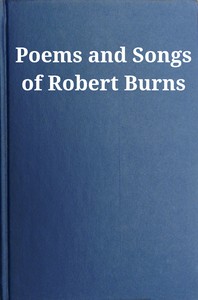
Poems and Songs of Robert Burns — Background and Themes
7
1
Project Gutenberg
2005
Songs, Scots -- Scotland -- Texts; Scotland -- Poetry
Readers of public-domain and historical texts
Project Gutenberg digital edition
en
Edition facts
Words: 142,828
Reading time: 621 min
Text sections: 553
Source:
Project Gutenberg record #1279
This collection of Robert Burns's poems and songs, arranged chronologically from 1771 to 1796, reveals how his verse moves between intimate lyric and public satire, with recurring images of winter, parting, and the natural world framing human emotion.
Editorial Edition Score
4.9/5
★★★★★
★★★★★
Calculated from edition completeness, EPUB availability, text structure and catalogue metadata. Not a user rating.
Edition quality
Robert Burns's Poems and Songs is arranged by year of composition, allowing readers to trace how his voice shifts across forms—from the early song "Handsome Nell" to the later epistles and political laments. The collection juxtaposes Scots dialect with formal English, and its structure highlights recurring motifs: the turning seasons, the pain of separation, and the contrast between rural life and urban or courtly settings. Burns often frames personal feeling through natural imagery, as in "The Winter It Is Past," where the speaker's sadness is set against the joy of birds and blooming flowers. This editorial note focuses on how the work's arrangement and repeated images create a coherent emotional landscape.
Chronological Structure and Shifting Voice
The poems are ordered by year, from 1771 to 1796, a span that covers Burns's entire known output. This arrangement foregrounds his development: early pieces like "Song—Handsome Nell" are light and conventional, while later works such as "The Chevalier's Lament" adopt a more somber, political tone. The chronological sequence also reveals how Burns returns to certain forms—epistles, elegies, and songs—across decades, adapting them to different subjects. For instance, the epistle to Hugh Parker (undated but placed late) uses a playful, self-deprecating voice, while earlier epistles like those to J. Lapraik are more earnest. The structure invites comparison between poems written in the same year, such as the comic "Death and Doctor Hornbook" and the tender "To a Mouse," both from 1785.
Recurring Images: Winter, Parting, and the Natural World
Winter appears repeatedly as a setting for loss and hardship. In "Winter: A Dirge" (1780), the season is linked to mourning, while in "The Bonie Lad That's Far Awa," the speaker contrasts "weary Winter" with the hope of spring and the return of a loved one. The image of the small bird singing recurs across poems: in "The Winter It Is Past," birds bring joy to others but not to the speaker; in "The Chevalier's Lament," the birds' song cannot soothe "joyless despair." Burns also uses natural cycles to frame human emotion—the rose on the breer, the primroses in dew—creating a consistent symbolic language. These images are not merely decorative; they anchor personal grief in a shared, observable world.
Movement Between Private and Public Grief
Many poems shift between intimate, personal sorrow and broader political or social commentary. "The Chevalier's Lament" begins with a natural scene of returning birds and flowers, then moves to the speaker's exile and the ruin of his "brave gallant friends." Similarly, "Man Was Made to Mourn: A Dirge" (1784) generalizes individual suffering into a universal condition. The song "The Bonie Lad That's Far Awa" stays personal—a woman abandoned by family, awaiting her lover and child—but its refrain of distance echoes the political laments. This movement is structural: Burns often opens with a specific, concrete image (a plough, a mouse, a pair of wine glasses) and expands outward to address larger themes, a technique visible across the collection.
Dialect, Diction, and the Shaping of Voice
Burns's use of Scots dialect is not uniform; it varies by poem and audience. In "The Twa Dogs" (1786), the dogs speak in broad Scots, while the narrator uses more standard English. In the epistle to Hugh Parker, Burns mocks the "uncouth clime" where words are "limpit in poetic shackles," yet he writes in a dense Scots that itself defies standard poetic diction. The glossary included in the collection signals that Burns expected some readers to need help with dialect. This mixing of registers creates a layered voice—sometimes rustic, sometimes refined—that shifts with the poem's subject. The songs, especially, blend Scots and English, as in "Verses to Clarinda," where the language is polished and courtly, contrasting with the earthier tones of "The Jolly Beggars."
Reading the poems in their chronological order reveals how Burns continually reworked a core set of images and concerns—love, loss, nature, and social justice—across different forms and tones. The collection rewards attention to the interplay between individual poems, especially those written in the same year. Rather than seeking a single narrative, readers may find value in tracing how a phrase or image recurs, transformed by context. The glossary is essential for full appreciation of the Scots pieces, but even without it, the emotional force of the verse is unmistakable.
Reader reflection
Before you leave, reflect on the book
Use these questions to collect your thoughts before moving on.
Your progress
0
/
10
2
How much did you enjoy the reading experience?
3
How likely are you to recommend this book?
4
Did the language feel accessible?
5
Did anything about the book feel genuinely new?
6
How strongly did the book affect you emotionally?
7
How well did it match your expectations?
8
Was the book easy to understand?
9
What changed or sharpened your thinking?
10