1

The Bab Ballads, with Which Are Included Songs of a Savoyard — Background and Themes
8
1
Project Gutenberg
2017
English wit and humor; Humorous poetry, English; Songs, English -- Texts
Readers of public-domain and historical texts
Project Gutenberg digital edition
en
Edition facts
Words: 67,810
Reading time: 295 min
Text sections: 21
Source:
Project Gutenberg record #54452
W.S. Gilbert's own illustrations accompany his comic verses and Savoy opera lyrics in this 1897 omnibus, where absurd characters like a Shakespeare lookalike and a sentry musing on political parties showcase his signature wit and metrical skill.
Editorial Edition Score
4.9/5
★★★★★
★★★★★
Calculated from edition completeness, EPUB availability, text structure and catalogue metadata. Not a user rating.
Edition quality
W.S. Gilbert's The Bab Ballads, with Which Are Included Songs of a Savoyard collects his comic verse from Fun magazine alongside lyrics from the Savoy operas, all illustrated by the author himself. The 1897 edition includes two hundred new drawings, which Gilbert hoped would correct what he called the 'unnecessary extravagance' of earlier illustrations. The poems range from narrative ballads about eccentric characters—such as a man cursed to resemble Shakespeare—to shorter comic pieces and political squibs like 'The Contemplative Sentry,' which observes that every child is born 'either a little Liberal, or else a little Conservative.'
Self-Illustrated Comic Verse
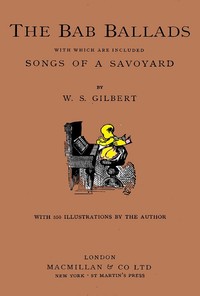
Gilbert's note explains that the original illustrations 'erred gravely in the direction of unnecessary extravagance,' a defect he aimed to correct with the new drawings in this volume. The excerpts show that the poems themselves often rely on exaggerated situations—a painter who persuades a Shakespeare lookalike to sit for him, or a sentry who philosophizes about politics while on duty. The illustrations, though not reproduced in this digital edition, are an integral part of the book's design, as Gilbert was both author and artist. The cover image, created by the transcriber, is a modern addition.
Recurring Comic Devices
Several poems in the excerpts employ a first-person narrator who recounts an absurd encounter. In the Shakespeare sonnet parody, the speaker paints a man who bears an uncanny resemblance to the Bard, only to hear the man complain about the social burdens of his face. The poem ends with the speaker's deflation: 'And, now I think of it, I don't!' Another piece, 'The Contemplative Sentry,' uses a refrain to underscore its political observation, while the ballad 'Captain Reece' (listed in the contents) likely follows a similar narrative pattern. Gilbert's verse often hinges on a single comic premise, developed through precise rhyme and meter.
Catalog Subjects vs. Actual Content
The Project Gutenberg record classifies this work under 'Science Fiction & Utopias,' yet the excerpts contain no science fiction or utopian themes. The poems are squarely in the tradition of English comic verse, with subjects including Shakespearean parody, military life, and political satire. The catalog subjects 'English wit and humor' and 'Humorous poetry, English' are accurate, while 'Songs, English -- Texts' reflects the inclusion of Savoy opera lyrics. The science fiction classification appears to be an error, perhaps arising from Gilbert's later work or a misattribution. Readers should approach the book as a collection of Victorian light verse and comic songs.
Gilbert's own account of the book's publication history—from the original Bab Ballads through More Bab Ballads and Fifty Bab Ballads to this combined edition—reveals his careful attention to his readers' preferences. The excerpts show a poet who delights in wordplay, absurd situations, and gentle social commentary. Readers interested in the origins of Gilbert's operatic style will find many precursors here.
Reader reflection
Before you leave, reflect on the book
Use these questions to collect your thoughts before moving on.
Your progress
0
/
10
2
Did this book hold your interest?
3
Is this a title you would suggest to others?
4
How easy was the book to follow?
5
Would this book work well in a reading group?
6
How understandable was the text?
7
Would you read this book again?
8
What did you think about the pace?
9
What did this book teach you most?
10