
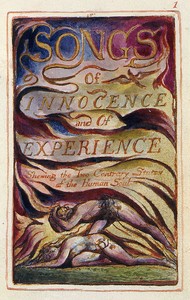
Songs of Innocence and of Experience by William Blake
Let's be clear: this isn't a novel with a plot. It's two collections of illustrated poems published years apart, meant to be read as a conversation. 'Songs of Innocence' (1789) paints a world of pastoral beauty and childlike faith. Poems like 'The Lamb' and 'The Echoing Green' celebrate a universe watched over by a gentle, loving God. It's all springtime and trust.
The Story
Then, in 1794, Blake added 'Songs of Experience.' This is the shadow to Innocence's light. Here, poems with parallel titles answer back. 'The Lamb' meets its counterpart, 'The Tyger,' a terrifying question about the creator of both gentle and fearsome beasts. The hopeful 'Infant Joy' is answered by the bitter 'Infant Sorrow.' The green, echoing fields are replaced by the soot-choked streets of 'London,' where Blake hears 'mind-forg'd manacles' in every cry. The story is the tension between these two states of being. Blake called them 'the two contrary states of the human soul,' and he presents them side-by-side, without forcing a conclusion.
Why You Should Read It
You should read this because it's shockingly modern. Blake was writing against the cold logic of the Industrial Revolution and rigid religious authority. His 'Experience' poems rage against child labor, prostitution, and a society that values profit over people—themes that echo loudly today. The genius is in the pairing. Reading 'The Chimney Sweeper' from Innocence (where a boy dreams of angelic rescue) right before the Experience version (where the boy is clearly exploited and abandoned) is a punch to the gut. It makes you feel the loss. This isn't dry philosophy; it's emotional archaeology of the human condition.
Final Verdict
Perfect for poetry-curious readers who are intimidated by older classics. The poems are short and accessible, but the ideas are massive. It's also a great pick for anyone interested in the roots of protest art or the timeless debate between nature and society. Grab an illustrated edition if you can—Blake's own wild artwork is part of the magic. Don't rush it. Read a few poems from each section and let the conversation between them sink in. It's a slim book that holds a universe of thought.
This text is dedicated to the public domain. You can copy, modify, and distribute it freely.
Susan Walker
5 months agoVery helpful, thanks.
Michael Martinez
4 months agoEnjoyed every page.
Mark Martin
3 months agoWithout a doubt, it provides a comprehensive overview perfect for everyone. Highly recommended.

Patricia Sanchez
2 years agoWithout a doubt, it provides a comprehensive overview perfect for everyone. Highly recommended.