1

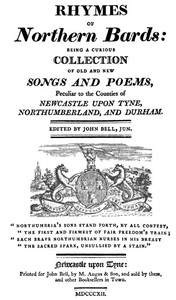
Rhymes of Northern Bards Being a Curious Collection of Old and New Songs and Poems, Peculiar to the Counties of Newcastle upon Tyne, Northumberland, and Durham — Text and Context
6
1
Project Gutenberg
2016
Ballads, English -- England, Northern -- Texts; England, Northern -- Poetry
Readers of public-domain and historical texts
Project Gutenberg digital edition
en
Edition facts
Words: 78,904
Reading time: 344 min
Text sections: 17
Source:
Project Gutenberg record #53156
This 1812 collection preserves dialect songs and poems from Newcastle, Northumberland, and Durham, featuring works by Thomas Whittle and others. The editor's preface frames the volume as a rescue mission for 'Reliques of Provincial Poetry,' while the poems themselves showcase local humor, rural life, and patriotic fervor, with a notable tension between preservation and personal satire.
Editorial Edition Score
4.8/5
★★★★★
★★★★★
Calculated from edition completeness, EPUB availability, text structure and catalogue metadata. Not a user rating.
Edition quality
John Bell's 1812 collection opens with a defensive preface that sets the tone for the entire volume. Bell quotes Pope on the impossibility of a 'faultless piece' and invokes a 'celebrated orator' who prized ballad-writing above law-giving. His stated aim is to rescue 'the productions of the Bards of the Tyne' from 'the yawning jaws of oblivion,' yet he simultaneously warns against personal allusions in provincial verse, quoting Pope's curse on poetry that 'makes one worthy man my foe.' This tension between preservation and satire runs throughout the collection.
A Curious Mix of Preservation and Satire
Bell's preface reveals a careful balancing act. He presents the collection as a repository for 'simple, yet popular effusions' that might otherwise be lost, but he is acutely aware that many of these poems contain personal attacks. The Italian proverb he offers—'CHI LAVA LA TESTA AL ASINO PERDE IL SAPONE' (he who washes the donkey's head wastes the soap)—suggests he expects criticism from those who find the collection uneven. The opening verses 'LINES SENT TO THE EDITOR AND PRINTER' praise the editors for bringing 'Taste and Genius forth' to Newcastle, framing the work as a civic improvement. Yet the poems themselves, like Thomas Whittle's 'The Midford Galloway's Ramble,' are full of rough humor and local feuds. Whittle's poem describes a horse that 'ne'er could be brought to behaviour' and 'had been so spoil'd in up-bringing,' a metaphor that could apply to the unruly verses Bell has gathered.
Thomas Whittle: The Eccentric Bard of Cambo
Thomas Whittle receives special attention in the collection. The editor includes a biographical note from the History of Northumberland (1811) that describes him as 'ingenious and eccentric,' whose 'comic productions often beguile the long winter evenings of our rustic Northumbrians.' The note acknowledges that Whittle was 'a profligate in his life, and sometimes licentious in his compositions,' but argues his best works 'sufficiently entitle him to our notice.' Whittle's poem 'Whimsical Love with Ann Dobson' opens with a scene at Cambo where the speaker sees his beloved 'more fresh than May' and feels love 'danc'd in my heart.' In contrast, 'The Midford Galloway's Ramble' is a rollicking, dialect-heavy tale of a horse that 'scamper'd right northward away' over 'rocks, over mountains and ditches.' The poem's tune is given as 'Ranting roaring Willy,' and its language is full of local terms like 'speels' (climbs) and 'gimmer' (a ewe).
Patriotism and the Borders
Alongside the comic and personal poems, the collection includes verses that celebrate Northumbrian military valor. One poem, dated January 2, 1807, and signed 'Bothwell,' addresses Northumbria directly: 'Such, such are the heroes in thy vallies rear'd, / Such, Northumbria, thy children still be.' It links the region's 'bold sons' to the battle of Trafalgar, where they fight 'for her king on Trafalgar's proud wave.' The poem contrasts the 'dark rolling clouds of the north' with the 'coward and slave' who shrinks from them, asserting that these blasts 'nerve the bold sons that Northumbria sends forth.' This patriotic strain sits uneasily alongside Whittle's satirical verses, suggesting the collection deliberately juxtaposes different registers of regional identity—from the mock-heroic to the genuinely heroic.
Readers should approach this collection as a historical document that captures the voices of a specific time and place, rather than as a polished literary anthology. The dialect spellings and inconsistent hyphenation noted by the transcriber are part of the text's character. Pay attention to the headnotes and biographical sketches, which reveal the editor's own anxieties about the material he has preserved. The poems reward close reading for their local references and linguistic play, even when their allusions to forgotten feuds remain obscure.
Reader reflection
What was your reading experience?
Capture what you thought, learned, and would like to remember.
Your progress
0
/
10
2
How did the book work for you overall?
3
Would you encourage someone else to read it?
4
How demanding did the text feel?
5
Did any part of the book feel personally relevant?
6
How useful were the ideas in this book?
7
How strongly did the book affect you emotionally?
8
Was the book easy to understand?
9
In one sentence, what did you learn?
10