1

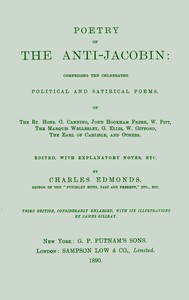
Poetry of the Anti-Jacobin Comprising the Celebrated Political and Satirical Poems, of the Rt. Hons. G. Canning, John Hookham Frere, W. Pitt, the Marquis Wellesley, G — A Reader’s Guide
6
3
Project Gutenberg
2020
English poetry; France -- History -- Revolution, 1789-1799 -- Poetry; Great Britain -- Politics and government -- 1789-1820
Readers of public-domain and historical texts
Project Gutenberg digital edition
en
Edition facts
Words: 125,794
Reading time: 547 min
Text sections: 58
Source:
Project Gutenberg record #63778
An 1890 edition of satirical poems from the late 1790s, targeting French revolutionary sympathizers and Whig politicians, with contributions by Canning, Frere, Pitt, and others, annotated by editor Charles Edmonds.
Editorial Edition Score
4.9/5
★★★★★
★★★★★
Calculated from edition completeness, EPUB availability, text structure and catalogue metadata. Not a user rating.
Edition quality
The poems in this collection first appeared in the weekly Anti-Jacobin (1797–98), a periodical founded to counter radical and revolutionary sentiment in Britain. The editor, Charles Edmonds, assembled them decades later with extensive footnotes that identify the real persons and events behind the satire. The verse is consistently topical, often parodying the style of contemporary poets or playwrights to mock their political leanings.
One notable feature is the collaborative authorship: contributors included statesmen like George Canning and William Pitt, alongside literary figures such as John Hookham Frere and George Ellis. The result is a blend of parliamentary inside knowledge and polished literary technique, aimed at a readership familiar with both current affairs and the conventions of Augustan satire.
Parody as Political Weapon
The Anti-Jacobin poets frequently borrowed the forms of sentimental drama and romance to undercut their subjects. In the excerpted play, characters like Casimere and Puddingfield speak in inflated, melodramatic phrases—"Courage without power is a contradiction"—that are immediately undercut by absurd situations, such as a Knight Templar working as a waiter. The parody targets the emotional excess and utopian rhetoric associated with radical writers. By placing high-flown sentiments in trivial contexts, the satirists imply that revolutionary ideals are equally hollow.
Another recurring technique is the mock-heroic: trivial actions are described in epic language, as when characters swear to "rescue, rescue, brave Rogero" in a chorus that mimics operatic convention. The effect is to deflate the seriousness of the cause being championed.
Diction and the Language of Party
The vocabulary of the poems is carefully chosen to signal political allegiance. Whig figures are given speeches peppered with abstract nouns like "liberty," "Magna Charta," and "Opposition"—terms that the Anti-Jacobin writers treat as empty catchphrases. In the excerpt, Beefington exclaims "to fly—to return—England—our country—Magna Charta—it is liberated—a new æra," the disjointed syntax suggesting frantic, thoughtless enthusiasm.
Conversely, the satirists' own voice, when it appears in editorial notes or framing verses, employs a cooler, more Latinate register. The contrast is deliberate: the radicals' language is portrayed as emotional and vague, while the conservative poets present themselves as rational and precise. This lexical opposition reinforces the political argument at the level of individual word choice.
Structure and the Fragmentary Form
Many pieces in the collection are presented as fragments—acts of plays, incomplete poems, or extracts from larger works. This is not accidental. The Anti-Jacobin often printed what purported to be excerpts from radical writings, then subjected them to ridicule in footnotes or mock-continuations. The effect is to suggest that the originals are incoherent or absurd, needing only to be shown in part to reveal their folly.
In the excerpted play, Act III is summarily dismissed: "contains the éclaircissements and final arrangement … which so nearly resemble the concluding act of Stella, that we forbear to lay it before our readers." This refusal to complete the narrative implies that the original is derivative and not worth serious attention. The fragmentary form thus becomes a rhetorical device, allowing the satirists to control what the reader sees and to imply that the rest is not worth seeing.
Recurring Details: The Bottle and the Waiter
Two motifs appear repeatedly in the excerpts: the struggle over a bottle and the figure of the waiter. The stage direction "Exeunt struggling for the bottle, but without anger or animosity" reduces a political or romantic conflict to a farcical tussle over alcohol. This trivialization is a hallmark of the collection's method: serious disputes are reframed as petty squabbles.
The waiter who is secretly a Knight Templar serves a similar function. He embodies the gap between appearance and reality that the satirists see in radical politics—a noble title hiding a menial role, a crusader turned servant. The revelation that "no waiter, but a Knight Templar" is part of a conspiracy to rescue a prisoner parodies the secret societies and plots that conservatives feared were fomenting revolution. By making the conspirators ridiculous, the poems seek to dispel the threat they represent.
Readers approaching this collection should be prepared for dense topical allusions. Edmonds's notes are essential for understanding the references, but the verse itself rewards attention to its verbal play and structural ingenuity. The poems are best read as period pieces that illuminate the political passions of the 1790s, not as timeless satire. Their value lies in the precision with which they capture the idioms and anxieties of their moment, and in the skill with which they turn those idioms against their users.
Reader reflection
Take a moment to reflect on this book
Create a short personal record of your experience with this book.
Your progress
0
/
10
2
How much did you enjoy the reading experience?
3
Would you encourage someone else to read it?
4
Did the language feel accessible?
5
Would you read this book again?
6
How did the reading compare with what you expected?
7
Did it raise ideas you would like to talk about?
8
Which aspect of the book did you value most?
9
What is the main idea you are taking away?
10