1

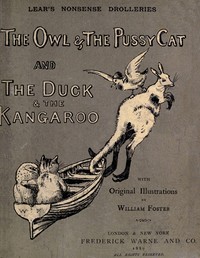
Nonsense Drolleries The Owl & The Pussy-Cat—The Duck & The Kangaroo. — Story, Setting & Ideas
4
1
Project Gutenberg
2006
Children's literature; English wit and humor; Nonsense verses, English; Humorous poetry, English
Readers of public-domain and historical texts
Project Gutenberg digital edition
en
Edition facts
Words: 3,851
Reading time: 17 min
Text sections: 1
Source:
Project Gutenberg record #20113
Edward Lear's two nonsense poems pair improbable animal couples in journeys that defy logic, using repetitive refrains, invented words, and rhythmic structures that emphasize movement and sound over narrative.
Editorial Edition Score
4.4/5
★★★★★
★★★★★
Calculated from edition completeness, EPUB availability, text structure and catalogue metadata. Not a user rating.
Edition quality
Edward Lear's Nonsense Drolleries presents two poems—"The Owl and the Pussy-Cat" and "The Duck and the Kangaroo"—that share a structural pattern: an animal pair embarks on a journey, encounters a negotiation, and resolves through a marriage or a ride. The poems rely on repetitive refrains (e.g., "You are, you are" or "Said the Duck to the Kangaroo") that create a chant-like rhythm. Invented place names like "the land where the Bong-tree grows" and "the Jelly Bo Lee" anchor the nonsense in a geography that is both specific and impossible. William Foster's original illustrations, mentioned in the publishers' preface, visually complement the verbal play.
Repetition as Structural Backbone
Both poems use repetition to build momentum and emphasize key moments. In "The Owl and the Pussy-Cat," the line "What a beautiful Pussy you are" is repeated three times, with the final "You are" set off by commas and line breaks. Similarly, "The Duck and the Kangaroo" repeats "Said the Duck to the Kangaroo" at the start of each stanza, creating a call-and-response pattern. This repetition is not merely decorative; it mimics the characters' persistence—the Duck's repeated plea for a ride, the Owl's repeated declaration of love. The refrains also serve as structural markers, dividing the poems into clear sections: courtship, journey, and resolution in the first; request, objection, and solution in the second.
Invented Words and Objects
Lear populates his poems with words that sound plausible but are entirely invented. The "runcible spoon" appears without explanation, yet its specificity suggests a tool for eating mince and quince. The "Bong-tree" and "Jelly Bo Lee" are place names that evoke exoticism without referents. The Duck's "worsted socks"—purchased to solve the Kangaroo's objection about wet feet—introduce a domestic object into an absurd scenario. These coinages are not random; they often rhyme with real words ("spoon" with "moon") or follow English morphological rules (adding "-y" to "Pig" to form "Piggy-wig"). The effect is a world that feels governed by its own logic, where a pig can sell a nose-ring for a shilling.
Movement Between Scenes
The poems are structured around abrupt shifts in location. In "The Owl and the Pussy-Cat," the couple sails "for a year and a day" to the Bong-tree wood, then marries on a hill, then dances on the sand—all in a few lines. The Duck and Kangaroo's journey is described as going "Over the land, and over the sea" to the Dee and Jelly Bo Lee, but the poem ends before they arrive. These transitions are swift and unelaborated, emphasizing the act of moving rather than the destination. The repeated phrase "hand in hand, on the edge of the sand" in the first poem and "over the fields and the water too" in the second reinforce a sense of perpetual motion. The illustrations by William Foster likely depicted these scenes, though the text alone conveys movement through verbs like "sailed," "hopped," and "danced."
Negotiation and Consent
Both poems hinge on a negotiation between characters. In "The Owl and the Pussy-Cat," Pussy proposes marriage but raises the practical problem of a ring; the Owl solves it by purchasing one from a pig. The transaction is straightforward: "Dear Pig, are you willing to sell for one shilling / Your ring?" The pig agrees without haggling. In "The Duck and the Kangaroo," the Kangaroo initially objects because the Duck's feet are "unpleasantly wet and cold," which could cause "roo-Matiz." The Duck counters by buying socks. These exchanges are polite and logical within the nonsense framework. The characters do not coerce; they persuade through practical solutions. This pattern of problem-and-resolution gives the poems a satisfying structure, even as the problems themselves are absurd.
Readers may notice that both poems end with a celebratory image—dancing by moonlight or a promised ride—but the journeys themselves remain open-ended. The Duck and Kangaroo never reach the Jelly Bo Lee; the Owl and Pussy-Cat simply dance. This refusal to conclude the journey is typical of Lear's nonsense, where the pleasure lies in the rhythm and invention rather than in arrival. Pay attention to how the poems use sound and repetition to create a sense of forward motion, even when the plot stands still.
Reader reflection
Take a moment to reflect on this book
Create a short personal record of your experience with this book.
Your progress
0
/
10
2
Did this book hold your interest?
3
How likely are you to recommend this book?
4
What was the reading difficulty like?
5
Which part made the strongest impression?
6
Did this book create an emotional response?
7
How did the reading compare with what you expected?
8
Did any part of the book feel personally relevant?
9
What is the main idea you are taking away?
10