1

Negro Poets and Their Poems — Key Ideas to Explore
5
2
Project Gutenberg
2019
American poetry -- African American authors; African Americans -- Poetry; African Americans -- Intellectual life; African American poets -- Biography; American poetry -- African American authors -- History and criticism
Readers of public-domain and historical texts
Project Gutenberg digital edition
en
Edition facts
Words: 59,485
Reading time: 259 min
Text sections: 12
Source:
Project Gutenberg record #60003
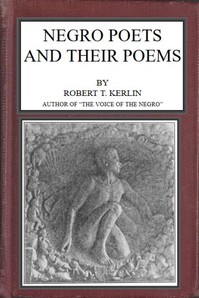
Kerlin's 1923 anthology surveys African American poetry from folk spirituals to early 20th-century art verse, profiling dozens of poets with critical commentary and excerpts. The collection reveals tensions between dialect tradition, formal European forms, and emerging free verse, while foregrounding women poets and the theme of aspiration amid adversity.
Editorial Edition Score
4.8/5
★★★★★
★★★★★
Calculated from edition completeness, EPUB availability, text structure and catalogue metadata. Not a user rating.
Edition quality
Kerlin opens his 1923 survey by dedicating the volume to the "Black and Unknown Bards" who created the spirituals, framing folk song as the foundation for later art poetry. The anthology moves chronologically from Jupiter Hammon and Phillis Wheatley through Paul Laurence Dunbar to contemporaries like Claude McKay and Langston Hughes, but its structure also groups poets by theme—womanhood, aspiration, dialect—revealing Kerlin's curatorial hand. A recurring pattern is the tension between received forms (sonnets, ballads) and the pressure of lived experience: Alice Dunbar-Nelson's "I Sit and Sew" uses a tight rhyme scheme to voice a speaker stifled by domesticity while war rages elsewhere.
Folk Roots and Art Ambitions
The first chapter distinguishes "untaught melodies" (spirituals and secular folk songs) from "the earlier poetry of art," a binary that shapes the whole book. Kerlin treats the spirituals as a "priceless treasure" but quickly moves to poets who adopted European forms—Phillis Wheatley's neoclassical couplets, George Moses Horton's romantic lyrics. The implicit question is whether Black poets must master white traditions to be recognized. Dunbar's dialect verse is praised for its "genius-quickening power," yet Kerlin also includes poets like J. Mord Allen who wrote in standard English. The anthology itself becomes a record of this stylistic negotiation.
The Heart of Negro Womanhood
Chapter III gathers seven women poets under a heading that risks essentialism, but the poems themselves resist easy categorization. Eva Jessye, Mrs. J. W. Hammond, Alice Dunbar-Nelson, Georgia Douglas Johnson, Angelina Grimké, Anne Spencer, and Jessie Fauset are each given individual treatment. Kerlin highlights Hammond's "To My Neighbor Boy," which contrasts a boy's violin with "syncopating 'jazz' or 'blues,'" suggesting a preference for refined sentiment. Dunbar-Nelson's "I Sit and Sew" and "The Lights at Carney's Point" use war imagery to critique enforced passivity. The section reveals how women poets navigated expectations of domesticity while addressing public themes.
Ad Astra per Aspera: Struggle and Ascent
The fourth chapter's Latin title—"through hardships to the stars"—organizes poets into those who suffered (Edward Smythe Jones, Raymond Garfield Dandridge) and those who triumphed (James C. Hughes, Roscoe C. Jamison). Kerlin's biographical notes often emphasize poverty, disability, or obscurity, framing the poetry as evidence of resilience. Dandridge, paralyzed and self-taught, is praised for sonnets that "free the soul from pain." The structure implies that hardship authenticates the verse, a lens that risks reducing art to autobiography. Yet the poems themselves—like Hughes's "Ad Astra"—insist on transcendence, creating a productive tension between Kerlin's framing and the poets' own aspirations.
New Forms and Dialect Verse
The final two chapters document formal experimentation. Chapter V covers free verse (Will Sexton, Langston Hughes) and prose poems (W. E. B. Du Bois, Kelly Miller), signaling a break from the metered, rhymed tradition that dominates earlier sections. Kerlin includes Hughes's early work, noting its departure from dialect. Chapter VI returns to dialect verse, featuring Waverly Turner Carmichael and others who continued Dunbar's legacy. The juxtaposition suggests that the anthology's arc is not linear progress but a coexistence of modes. Kerlin does not resolve the tension between folk authenticity and modernist innovation, leaving readers to weigh the competing claims of tradition and change.
Kerlin's anthology is best read as a document of its moment—1923, midway between the New Negro Renaissance and the Harlem Renaissance's full flowering. The editor's choices reveal as much about early 20th-century critical taste as about the poets themselves. Readers may wish to compare Kerlin's assessments with later evaluations, noting which poets have endured and which have faded. The volume's value lies less in its judgments than in the range of voices it preserves, many of which remain difficult to find elsewhere.
Reader reflection
Record your reading impressions
A brief reflection can help important ideas stay with you longer.
Your progress
0
/
10
2
How much did you enjoy the reading experience?
3
Would you recommend this book to another reader?
4
What was the reading difficulty like?
5
What was the strongest part of the book?
6
Is this a title worth rereading?
7
What was its emotional impact?
8
Did the story or argument move comfortably?
9
What did this book teach you most?
10