
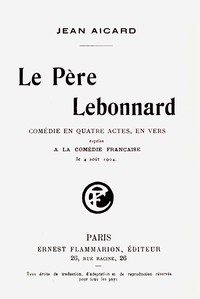
Le Père Lebonnard : Comédie en 4 actes, en vers, reprise à la Comédie…
Jean Aicard's Le Père Lebonnard is a four-act verse comedy that feels both charmingly old-fashioned and surprisingly relevant. First performed in 1889, it takes us into the heart of a very specific family drama.
The Story
Père Lebonnard is a master porcelain painter in a small French town. He’s a widower, deeply dedicated to his craft, and content with his simple, traditional life. His peace is shattered when his daughter, Jeanne, returns from her convent education. She’s bright, idealistic, and in love with a young painter named André who wants to whisk her away to the artistic whirlwind of Paris. For Lebonnard, Paris represents everything shallow and corrupt. He believes true art is found in honest, local craftsmanship, not in big-city salons. The play becomes a battle of wills. Jeanne fights for her future and her love, while her father fights to protect her from what he sees as a disastrous path, all while grappling with his own loneliness and fear of change.
Why You Should Read It
Don't let the 'verse comedy' label scare you off. The rhyming dialogue gives it a musical, almost playful rhythm that makes the serious themes go down easy. The core of the play is the father-daughter conflict, and it’s written with real heart. You can feel Lebonnard's fear—it’s not just stubbornness, but a genuine terror that the world he understands is vanishing and taking his daughter with it. Jeanne isn't just a rebellious teen; she’s a young woman logically arguing for her own life. I found myself sympathizing with both sides, which is the mark of good writing. It’s also a fascinating snapshot of a time when art was democratizing, and the clash between 'high art' and 'craft' was a hot topic.
Final Verdict
This is a perfect little read for anyone who enjoys classic plays, historical family dramas, or stories about artists. It’s short, focused, and packed with emotion. You don’t need to be a French literature scholar to enjoy it; you just need to have ever disagreed with a parent about your life choices. If you liked the generational tensions in something like Fiddler on the Roof or the artistic debates in My Name is Asher Lev, you’ll find a kindred spirit in old Père Lebonnard. It’s a gentle, thoughtful comedy with a lot of soul.
You are viewing a work that belongs to the global public domain. Feel free to use it for personal or commercial purposes.
Kevin Nguyen
4 months agoSimply put, the narrative structure is incredibly compelling. Highly recommended.





Steven Lewis
7 months agoWithout a doubt, the narrative structure is incredibly compelling. I learned so much from this.