
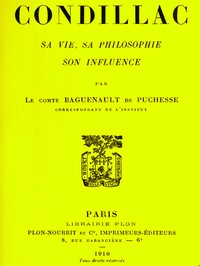
Condillac: sa vie, sa philosophie, son influence by Baguenault de Puchesse
Let's be honest, a 19th-century biography of an 18th-century philosopher doesn't exactly scream 'page-turner.' But stick with me. Gustave Baguenault de Puchesse's book, Condillac: sa vie, sa philosophie, son influence, is more compelling than you'd think. It's a three-part deep dive into a thinker who tried to map the human mind like a scientist maps a new land.
The Story
This isn't a novel with a plot, but it follows a clear arc. The first part sketches Condillac's life. He wasn't a fiery revolutionary; he was a quiet, studious abbé who moved in Enlightenment circles with guys like Diderot and Rousseau. The real action is in part two, which unpacks his core philosophy. Condillac took John Locke's idea of the mind as a 'blank slate' and ran with it. He used a famous thought experiment: imagine a statue that gradually gains senses, one by one. He argued that from smell alone, then touch, then sight, this statue could build an entire world of thought and reason. Everything comes from sensory experience. The final part of the book is where it gets juicy—it traces how this idea, called 'sensationalism,' didn't just stay in books. It influenced economists, educators, and later philosophers, weaving itself into the intellectual fabric of the 19th century.
Why You Should Read It
What grabbed me was how personal Condillac's quest feels. He was trying to solve a puzzle we all face: how do we know what we know? Reading his theory feels like watching someone build a complex Lego castle from just a handful of basic bricks. Baguenault de Puchesse does a solid job of making this clear without oversimplifying it. He shows Condillac not as a dusty genius, but as a man connecting dots. You see how his ideas about learning from the senses fed directly into new, more practical approaches to education. It makes you realize that big cultural shifts often start with one person's quiet obsession with a fundamental question.
Final Verdict
This book is a specific treat. It's perfect for history or philosophy buffs who enjoy seeing how ideas travel and evolve. If you liked books like The Philosophie or are curious about the undercurrents of the Enlightenment beyond the big names like Voltaire, you'll find a lot here. It's also great for anyone in psychology or education who wants a historical perspective on how we think about thinking. Fair warning: it's a scholarly work, so it demands your attention. But if you're up for it, it's a rewarding look at the hidden architecture of modern thought.
This is a copyright-free edition. You are welcome to share this with anyone.
Joshua Gonzalez
8 months agoBeautifully written.
Michelle Smith
7 months agoBased on the summary, I decided to read it and the atmosphere created is totally immersive. Don't hesitate to start reading.
Edward Young
1 year agoEnjoyed every page.


Kimberly Thompson
1 year agoI have to admit, the narrative structure is incredibly compelling. This story will stay with me.