1

Lalla Rookh — A Reader’s Guide
7
2
Project Gutenberg
2025
Love stories; Frame stories; Poets -- Fiction; Storytellers -- Fiction; Orient -- Fiction; Narrative poetry, English
Readers of public-domain and historical texts
Project Gutenberg digital edition
en
Edition facts
Words: 80,686
Reading time: 351 min
Text sections: 22
Source:
Project Gutenberg record #76794
Thomas Moore's 1817 Oriental romance Lalla Rookh weaves a frame story of a princess's journey with four verse tales, marked by ornate imagery, shifting narrative speeds, and a dramatic storm sequence that contrasts calm and chaos.
Editorial Edition Score
4.9/5
★★★★★
★★★★★
Calculated from edition completeness, EPUB availability, text structure and catalogue metadata. Not a user rating.
Edition quality
Thomas Moore's Lalla Rookh opens with a frame: a princess traveling to her betrothed, entertained by a poet whose tales form the bulk of the work. The narrative voice shifts between the leisurely pace of the journey and the intense, rapid-fire action of the embedded stories. In one excerpt, a storm at sea is rendered with breathless accumulation—"a second crash—a third—and now, as if a bolt of thunder had riv'n the labouring planks asunder"—before giving way to a serene aftermath described in long, flowing lines. This alternation between violent upheaval and lyrical calm is a structural signature.
Pace and the Storm Sequence
The most striking change in pace occurs during the shipwreck episode. Moore builds tension through short, fragmented clauses: "Clash'd swords, and tongues that seem'd to vie / With the rude riot of the sky." The rhythm accelerates with exclamations and dashes: "But, hark!—that war-whoop on the deck— / That crash." Then, abruptly, the storm ceases, and the verse expands into a meditative catalogue of calm: "How calm, how beautiful comes on / The stilly hour, when storms are gone." This juxtaposition is not merely descriptive; it mirrors the emotional trajectory of the heroine Hinda, who sinks into a death-like swoon and awakens to tranquility. The pacing thus becomes a tool for psychological contrast.
Recurring Imagery of Light and Fire
Throughout the excerpts, light and fire appear in varied forms: the "lightning-gem" of the storm's aftermath, the "meteor brands" of sabres, and the "Star of Egypt" that "Burns through the storm with looks of flame." The Veiled Prophet is associated with a "fiendish laugh" and a throne raised by "blind belief." Even in the storm, the heroine catches a glimpse of an "unearthly form" shining "above his fellow-men." This recurring imagery creates a visual thread linking the frame narrative and the tales, though the excerpts do not reveal whether these motifs resolve into a coherent symbolic system.
Narrative Voice and Direct Address
Moore's narrator frequently interjects with exclamations and rhetorical questions: "Merciful Heaven! what can it be?" and "Whose was the hand that turn'd away / The perils of the' infuriate fray?" These moments heighten immediacy and draw the reader into the action. The voice also shifts to a more detached, descriptive register in calmer passages, as when cataloguing the aftermath: "When the light blossoms, rudely torn / And scatter'd at the whirlwind's will, / Hang floating in the pure air still." This alternation between involved and observational tones gives the narrative a dynamic, almost theatrical quality, consistent with the work's status as a romance intended for oral performance.
Structure of the Embedded Tales
The frame story of Lalla Rookh's journey is punctuated by four verse tales, each introduced by the poet Feramorz. The excerpts include portions of "The Veiled Prophet of Khorassan" and a later storm episode likely from another tale. The transitions between frame and tale are not always explicit in the excerpts, but the shift in setting—from the princess's caravan to the Prophet's throne or a ship at sea—is marked by changes in pace and imagery. The tales themselves contain internal shifts, such as the Prophet's sudden revelation: "He raised his veil—the Maid turn'd slowly round, / Look'd at him—shriek'd—and sunk upon the ground!" This suggests a pattern of suspense and reversal that may recur across the work.
The Role of the Illustrations
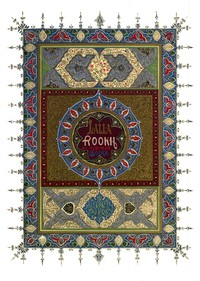
This edition includes sixty-nine illustrations by John Tenniel and five ornamental pages by T. Sulman. The list of illustrations provides captions that echo key moments in the text, such as "He raised his veil—the Maid turn'd slowly round" and "All fire at once the madd'ning zeal she caught." These images likely reinforce the dramatic peaks identified in the narrative, offering visual counterparts to the shifts in pace and intensity. The presence of multiple illustrators suggests a deliberate effort to match visual style to the romance's varied moods, though the excerpts do not describe the illustrations themselves.
Readers may find it useful to attend to the transitions between the frame and the embedded tales, noting how Moore signals these shifts through changes in verse form and narrative speed. The storm sequence, in particular, rewards close attention to its rhythmic structure. The illustrations by Tenniel and Sulman offer a contemporary visual interpretation that may illuminate the text's dramatic emphases.
Reader reflection
Take a moment to reflect on this book
Create a short personal record of your experience with this book.
Your progress
0
/
10
2
Did this book hold your interest?
3
How likely are you to recommend this book?
4
How demanding did the text feel?
5
Did the story or argument move comfortably?
6
Which aspect of the book did you value most?
7
Did it raise ideas you would like to talk about?
8
Was the book easy to understand?
9
What did this book teach you most?
10