1

Biography for Beginners Being a Collection of Miscellaneous Examples for the Use of Upper Forms — Context and Discussion
4
1
Project Gutenberg
2014
Nonsense verses; Humorous poetry; Caricatures and cartoons; Clerihews
Readers of public-domain and historical texts
Project Gutenberg digital edition
en
Edition facts
Words: 5,019
Reading time: 22 min
Text sections: 2
Source:
Project Gutenberg record #46691
A collection of short, humorous biographical poems called clerihews, invented by E. C. Bentley, each offering a witty, often irreverent take on historical figures, accompanied by G. K. Chesterton's caricature-like diagrams.
Editorial Edition Score
4.5/5
★★★★★
★★★★★
Calculated from edition completeness, EPUB availability, text structure and catalogue metadata. Not a user rating.
Edition quality
This volume presents a series of clerihews—four-line biographical poems invented by E. C. Bentley—each offering a compact, often irreverent take on a historical figure. The form, named after Bentley's middle name, typically uses the subject's name in the first line and then twists expectation with a comic or mundane detail. For instance, Sir Christopher Wren is depicted not designing St. Paul's but instructing his servant to say he is 'dining with some men.' The humor lies in the contrast between the subject's public stature and the trivial or absurd private moment imagined.
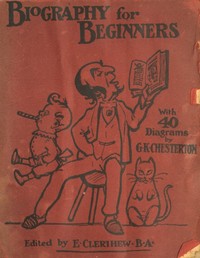
G. K. Chesterton's '40 Diagrams' (as the title page announces) accompany the verses with caricature-like drawings. The catalog subjects classify the work as nonsense verses and humorous poetry, and the excerpts confirm that the poems consistently undercut biographical grandeur with bathos and wordplay.
The Clerihew Form and Its Rules
The clerihew, as demonstrated in these excerpts, follows a loose structure: two rhyming couplets, with the first line ending in the subject's name. The meter is irregular, often conversational, and the rhyme can be deliberately clumsy. For example, 'Sir Christopher Wren / Said, "I am going to dine with some men. / If anybody calls / Say I am designing St. Paul's."' The humor derives from the absurd juxtaposition of the grand architectural project with a mundane social excuse. Bentley's verses rarely praise; they deflate. Sir Humphrey Davy 'abominated gravy' and 'lived in the odium / Of having discovered Sodium.' The form allows for personal quirks—John Stuart Mill 'overcame his natural bonhomie' to write economics—and even macabre jokes, as with Lord Clive: 'What I like about Clive / Is that he is no longer alive.'
Chesterton's Diagrams and the Visual Dimension
The title page promises '40 Diagrams by G. K. Chesterton,' and while the excerpts do not include the illustrations, the catalog metadata confirms their presence. Chesterton, better known as a writer and apologist, was also a skilled caricaturist. His drawings likely amplify the poems' satirical tone, reducing historical figures to cartoonish proportions. The combination of text and image aligns the book with the tradition of illustrated humor, akin to Edward Lear's nonsense but with a biographical target. The 'diagrams' label itself is ironic, suggesting a pseudo-scientific or educational purpose that the verses mock. Readers should consider how the visual gags might interact with the verbal ones, especially in entries like 'The Duke of Wellington' or 'Jane Austen,' where the drawing could underscore the poet's irreverence.
Range of Subjects and Historical Play
The table of contents lists over forty figures, from ancient to contemporary, including artists (Tiziano Vecelli, Cimabue), writers (Cervantes, Jane Austen), scientists (Marconi, Professor James Dewar), and politicians (President Roosevelt, the Duke of Fife). The selection is eclectic, mixing canonical names with obscure ones like 'Besant and Rice' or 'Mr. T. Werner Laurie' (the publisher). This range suggests Bentley's aim was not systematic biography but playful commentary. The 'Introductory Remarks' set the tone: 'The Art of Biography / Is different from Geography. / Geography is about Maps, / But Biography is about Chaps.' The poems reduce complex lives to a single, often silly detail—King Edward the Confessor 'slept under the dresser'—inviting readers to question what biography typically omits. The humor is gentle but pointed, relying on shared cultural knowledge that may now require footnotes.
These clerihews reward reading aloud, where their off-kilter rhythms and rhymes become apparent. The brevity of each entry (four lines) makes the collection ideal for dipping into, but the cumulative effect reveals a consistent satirical stance toward historical reverence. Chesterton's illustrations, though absent from this text, are integral to the original design. Readers interested in the form's later use by other poets, or in Bentley's own biography, may find additional context in the work's publishing history.
Reader reflection
Record your reading impressions
A brief reflection can help important ideas stay with you longer.
Your progress
0
/
10
2
How did the book work for you overall?
3
Would you recommend this book to another reader?
4
What was the reading difficulty like?
5
Did the book give you something worth debating?
6
Could you see yourself revisiting this book?
7
How clearly were the main ideas presented?
8
How useful were the ideas in this book?
9
What changed or sharpened your thinking?
10