
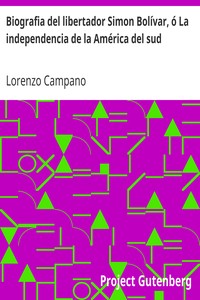
Biografia del libertador Simon Bolívar, ó La independencia de la América del…
Lorenzo Campano's Biografia del libertador Simon Bolívar is a 19th-century snapshot of a legend, written while the memory of the man was still fresh. Published in 1864, it's a product of its time, offering a perspective that later, more academic biographies sometimes smooth over.
The Story
The book follows the incredible arc of Simón Bolívar's life. It starts with his privileged upbringing in Caracas and traces his transformation into 'The Liberator.' You get the major campaigns—the daring crossings of the Andes, the pivotal battles like Boyacá and Carabobo that shattered Spanish rule across modern-day Venezuela, Colombia, Ecuador, Peru, and Bolivia. But Campano doesn't stop at the battlefield triumphs. He pushes into the far trickier territory of what came next: the political infighting, the struggle to forge a unified Gran Colombia, and Bolívar's increasing authoritarianism as his dream of unity crumbled around him. It ends with his lonely, disillusioned death, a hero who felt he had failed.
Why You Should Read It
What makes this special is its immediacy. Campano wasn't looking back across centuries; he was writing for people who lived in the world Bolívar created. You can feel him wrestling with Bolívar's legacy. Was he a flawless hero or a tragic figure who couldn't control the forces he unleashed? The book doesn't give easy answers. It presents a man of immense will and vision, who was also ruthless, proud, and ultimately overwhelmed by regional loyalties and personal rivalries. You see the human cost of independence, not just in battles, but in broken alliances and political chaos. It's a reminder that freeing a nation is one thing, but building a functioning country is a whole other, often messier, fight.
Final Verdict
This is a fantastic read for anyone interested in Latin American history who wants to go beyond the basic hero narrative. It's not a simple cheerleading piece. It's a complex, sometimes critical portrait from an era still grappling with Bolívar's impact. Be prepared for the 19th-century prose style—it's formal but full of passion. If you enjoy primary sources and seeing how historical figures were viewed by the generations that immediately followed them, you'll find this absolutely absorbing. It's less a polished monument and more a lively, urgent conversation about power, revolution, and legacy.
You are viewing a work that belongs to the global public domain. Preserving history for future generations.
Nancy Torres
1 year agoJust what I was looking for.
Oliver Anderson
1 year agoBeautifully written.
Donna Lewis
11 months agoWithout a doubt, the narrative structure is incredibly compelling. Definitely a 5-star read.
Logan Flores
1 year agoText is crisp, making it easy to focus.



Margaret Lewis
1 year agoHonestly, the arguments are well-supported by credible references. I will read more from this author.