
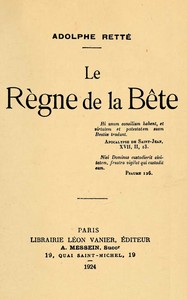
Le règne de la bête by Adolphe Retté
Adolphe Retté's Le règne de la bête isn't a novel with a twisty plot. Think of it more as a guided tour through a nightmare version of 1890s Paris, led by a guide who is equal parts prophet and critic.
The Story
The book follows a disillusioned intellectual as he wanders through the streets of Paris. He doesn't see beauty or romance. Instead, he sees the 'Beast' everywhere. The Beast is the cold logic of science that kills wonder. It's the clanking machinery of industry that grinds down human spirit. It's the empty pursuit of money and pleasure in the city's cafes and boulevards. The story is built from these vivid, often bitter, observations. We move from scenes of wealthy decadence to the misery of the poor, all filtered through the narrator's conviction that society has chosen materialism over God, and is doomed for it.
Why You Should Read It
You read this book for the voice. Retté's anger is electric. Even if you don't agree with his ultra-conservative, Catholic conclusions, his passion is undeniable. He makes you feel the weight of a changing world. His descriptions are sharp and memorable—he doesn't just say 'the city is noisy,' he makes you hear the Beast's roar in the traffic. It's a fascinating historical snapshot of a very specific fear: the terror that everything sacred is being paved over by progress. It also feels weirdly current. Swap 'industrial machines' for 'social media algorithms' and his warnings about technology disconnecting us from our humanity hit close to home.
Final Verdict
This book is a specialized taste, but a rewarding one. It's perfect for readers who love history and want to understand the fierce cultural wars of the late 1800s beyond the dry facts. If you enjoy passionate, opinionated writing from authors who take a firm stand—think of it as the 19th-century version of a fiery podcast or essay—you'll be captivated. Approach it not for a relaxing story, but for a bracing, intellectual argument with a brilliant and troubled mind. Just be prepared for the author to yell his points at you. He doesn't whisper.
The copyright for this book has expired, making it public property. It is available for public use and education.


Carol Anderson
1 year agoWithout a doubt, the author's voice is distinct and makes complex topics easy to digest. Exceeded all my expectations.