1

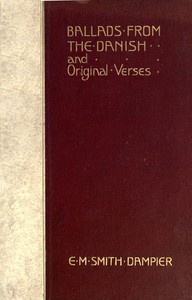
Ballads from the Danish and Original Verses — Story, Setting & Ideas
7
1
Project Gutenberg
2022
English poetry; Danish poetry -- Translations into English
Readers of public-domain and historical texts
Project Gutenberg digital edition
en
Edition facts
Words: 11,978
Reading time: 53 min
Text sections: 3
Source:
Project Gutenberg record #68204
A 1910 collection pairing English translations of Danish ballads with original poems, marked by strict metrical fidelity, supernatural encounters, and recurring motifs of doomed love, werewolves, and the dead returning.
Editorial Edition Score
4.5/5
★★★★★
★★★★★
Calculated from edition completeness, EPUB availability, text structure and catalogue metadata. Not a user rating.
Edition quality
E. M. Smith-Dampier’s Ballads from the Danish and Original Verses (1910) opens with a translator’s note insisting that “the metre of the original has in all cases been scrupulously followed”—a pledge that shapes the collection’s distinctive, often irregular rhythms. The book divides into two halves: ten translations from Danish folk ballads, then five original poems on British historical subjects. Across both sections, the same preoccupations surface: the dead refuse to stay buried, love persists beyond the grave, and supernatural beings—trolls, mermen, werewolves—test human courage and faith.
Metrical Fidelity and Its Effects
Smith-Dampier’s commitment to preserving original metres produces lines that can feel deliberately rough-hewn. In “King Olaf and the Trolls,” the steersman’s warning about the troll’s “eyes like a burning brand” sits beside a refrain—“Red as the ruddy gold, the sun sets over Trondhjem”—that breaks the ballad’s four-stress pattern. The effect is not smoothness but a kind of archaic urgency. In “The Avenging Sword,” the metre shifts to accommodate dialogue, while “The Knavish Merman” uses a shorter, quicker line for the merman’s taunts. This scrupulousness means the translations often read as though they were sung, with stresses falling in unexpected places. Readers attuned to the sound of verse will notice how Smith-Dampier sacrifices idiomatic English to preserve the Danish originals’ pulse.
The Dead Who Will Not Stay Buried
Several ballads hinge on the return of the dead. In “Ballad of Sir Herluin,” a dying knight rides to a churchyard and calls his beloved Margaret from her grave. She rises “in her winding-sheet” and assures him that “the grave’s not deep nor wide enough / To sunder me and thee.” The poem ends with her promise that “love is lord of all,” but the scene is chilling: the corpse speaks, kisses his brow, and bids him lie down in the mould. “Rime of the Dead Lover” and “Lovel and John” similarly feature revenants who return for unfinished business. These are not gentle ghosts; they are figures who disrupt the boundary between life and death, and Smith-Dampier gives them a stark, unadorned voice. The repeated motif suggests a fascination with the idea that strong emotion—especially love or guilt—can override physical death.
Werewolves, Trolls, and the Threat of the Other
The supernatural beings in these ballads are rarely benign. The troll in “King Olaf and the Trolls” has “nails stand out, like the horns of a buck” and a “long and loathly tail”; Saint Olaf defeats him not by force but by a charm that traps him in stone until Doomsday. In “The Wood-Raven,” a hunter pursues a beast into a ruined kirk, only to find that the dying animal wears “a dead man’s face”—his own son, transformed into a werewolf. The horror is explicit: “Woe, woe! in the were-wolf’s grisly guise, / Oh king, thou hast slain thy son!” These encounters dramatize a world where the boundary between human and monster is permeable, and where the hero’s own violence can turn against him. Smith-Dampier’s translations emphasize the physical grotesqueness of these creatures, grounding the supernatural in vivid, unsettling detail.
Because the excerpts are incomplete, the full arc of the original poems—especially those on Jacobite themes like “The Riding of the Shee” and “Ballad of London Town”—remains unclear. Readers should approach the collection as two distinct but interlocking sequences: the Danish translations, with their stark supernaturalism, and the original verses, which may offer a different register of loss and loyalty. Pay attention to how Smith-Dampier handles refrains and repeated lines, as these often carry the emotional weight of the ballad form.
Reader reflection
Record your reading impressions
A brief reflection can help important ideas stay with you longer.
Your progress
0
/
10
2
What was your overall reaction to the book?
3
Would you pass this book on to a friend?
4
How demanding did the text feel?
5
Could you apply anything you learned?
6
How much did the book move you?
7
How strong was your personal connection to the text?
8
Which element worked best for you?
9
What is the main idea you are taking away?
10