1

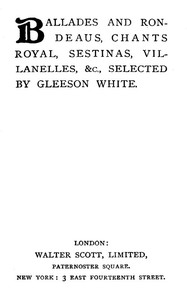
Ballades and Rondeaus, Chants Royal, Sestinas, Villanelles, etc. — Inside the Classic
5
2
Project Gutenberg
2014
English poetry -- 19th century; American poetry -- 19th century; English language -- Versification; Provençal poetry -- History and criticism; Ballades; Rondeaus
Readers of public-domain and historical texts
Project Gutenberg digital edition
en
Edition facts
Words: 77,644
Reading time: 338 min
Text sections: 17
Source:
Project Gutenberg record #45736
This anthology collects late-Victorian English and American poems in French fixed forms: ballades, rondeaus, chants royal, sestinas, villanelles, and more. Gleeson White's preface and dedication to Robert Louis Stevenson frame the revival of these 'dainty modes,' while the poems themselves explore love, loss, art, and modernity through intricate repetition and refrains.
Editorial Edition Score
4.7/5
★★★★★
★★★★★
Calculated from edition completeness, EPUB availability, text structure and catalogue metadata. Not a user rating.
Edition quality
Gleeson White's anthology opens with a dedication to Robert Louis Stevenson, acknowledging him as an early experimenter in 'French rhythms' who introduced Charles d'Orléans and François Villon to English readers. The epigraph from George Macdonald praises these forms for their 'bell-like returns upon themselves' and 'music of triangle and cymbal'—a description that anticipates the collection's emphasis on sound and structure over narrative. White's selection, drawn from both British and American poets, arranges poems by form rather than theme, creating a catalogue of metrical ingenuity. The index lists authors and sources, including periodicals like Longman's Magazine and Belgravia, situating the poems in their original print contexts.
The Refrain as Structural Anchor
Across the collection, the refrain functions not merely as a repeating line but as a pivot for meaning. In John Payne's 'Double Ballad. Of the Singers of the Time,' the line 'Songs and singers are out of date' recurs at the end of each stanza, its tone shifting from lament to indictment as the poem catalogues urban blight and lost faith. Similarly, A. Mary F. Robinson's 'A Ballad of Lost Lovers' uses 'Half-remembered and half-forgot' to evoke a limbo where mythical and historical lovers wander, the refrain's slight variations mirroring their fading memories. The villanelles and rondeaus in later sections rely on even tighter repetition, often alternating two refrains to create a sense of obsessive circling. White's selection foregrounds how these poets exploit the tension between fixed form and emotional variation.
Movement Between Myth and Modernity
Several poems juxtapose classical or medieval figures with contemporary settings. In 'A Ballad of Lost Lovers,' Orpheus, Sappho, and Francesca appear alongside 'fair Rosamond and French Heaulmière,' blending literary and historical references into a single ghostly forest. Conversely, Payne's 'Double Ballad' contrasts 'meadow and lane' with 'acres of brick in the pitiless rain,' lamenting the loss of pastoral beauty to industrialization. This movement between eras is mirrored in the anthology's structure: ballades about ancient heroes sit beside poems on modern ennui. The chants royal and sestinas often sustain a single image or argument across longer stanzas, while the shorter rondeaus and triolets pivot swiftly from the mundane to the lyrical. White's arrangement encourages readers to trace these shifts in scale and subject.
Recurring Images: Birds, Birdsong, and Flight
Birds and their songs appear as a persistent motif, often linked to the act of poetic creation. The epigraph from Macdonald compares the forms to 'bird-song—to unconscious seeming through most unconscious art,' and several poems develop this analogy. In Oscar Fay Adams's 'Pipes of Pan,' the god's pipes evoke a pastoral music that rivals birds. Elsewhere, 'Of Antique Dances' by W. E. Henley describes dancers moving 'like birds that poise and preen,' while 'Of Summer' by Andrew Lang imagines 'the swallow's flight' as a measure of seasonal change. The villanelles, with their alternating refrains, mimic the call-and-response of birdsong. This recurring imagery ties the formal repetition of the poems to a natural world that is both idealized and elegiac, as in Payne's lament that 'song is a flower that will droop and wane' without a 'heaven toward which to grow.'
The Editor's Hand: Selection and Sequence
White's editorial choices shape the reader's experience of these forms. The index marks previously unpublished poems with an asterisk and italicizes American authors, signaling a deliberate mix of established and emerging voices. The sequence moves from ballades—the most represented form—through rondeaus, chants royal, sestinas, and villanelles, each section grouping poems by structure rather than theme. This organization invites comparison: a ballade by Austin Dobson on a fan sits near one by Andrew Lang on primitive man, highlighting the form's adaptability. The preface, though brief, frames the collection as a record of 'the variety of dainty modes' revived in the late nineteenth century. By including poems from periodicals and first editions, White preserves the ephemeral contexts in which these forms were debated and practiced, making the anthology a document of literary fashion as much as a treasury of verse.
Readers approaching this collection will find it rewards attention to pattern and variation. The refrains and repeated lines are not mere ornaments but engines of meaning, shifting with each recurrence. White's arrangement by form rather than theme encourages browsing across poets and periods, revealing how the same structure can serve elegy, satire, or praise. For those interested in prosody, the book offers a practical survey of fixed forms in English; for others, it provides a window into the late-Victorian fascination with medieval and French models—a fascination that shaped the era's poetic experiments.
Reader reflection
Take a moment to reflect on this book
Create a short personal record of your experience with this book.
Your progress
0
/
10
2
Was reading this book enjoyable?
3
Is this a title you would suggest to others?
4
What was the reading difficulty like?
5
Would you like to discuss this book with someone?
6
Could you see yourself revisiting this book?
7
How much did the book move you?
8
How well did it match your expectations?
9
What did this book teach you most?
10