1

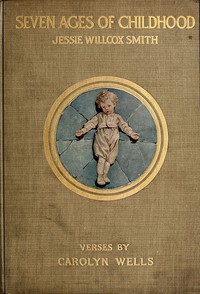
The Seven Ages of Childhood — Story, Setting & Ideas
4
1
Project Gutenberg
2014
Children's poetry, American; Children in art; Children -- Juvenile poetry; Aging -- Juvenile poetry; Youth in art
Readers of public-domain and historical texts
Project Gutenberg digital edition
en
Edition facts
Words: 6,228
Reading time: 28 min
Text sections: 1
Source:
Project Gutenberg record #45270
Carolyn Wells's verses and Jessie Willcox Smith's illustrations trace childhood from infancy to first love, with catalog subjects like 'Children in art' and 'Aging' reflected in the poem's seven-stage structure, though the excerpts show a focus on emotional interiority rather than physical aging.
Editorial Edition Score
4.4/5
★★★★★
★★★★★
Calculated from edition completeness, EPUB availability, text structure and catalogue metadata. Not a user rating.
Edition quality
Carolyn Wells's verses in The Seven Ages of Childhood explicitly follow a seven-stage progression from infancy to first love, mirroring Shakespeare's 'seven ages' but applied to childhood. The catalog subjects list 'Aging -- Juvenile poetry' and 'Youth in art,' yet the excerpts reveal that the poem dwells less on physical change and more on the child's inner world: the infant is described as a 'human mystery' who 'cannot think or talk,' while the toddler is defined by sensory exploration. The structure is linear, but the emotional register shifts from detached observation to empathetic participation as the child grows.
Infancy as a State of Being
The opening poem, 'First the Infant in Its Mother's Arms,' presents the baby not as a developing person but as a static enigma. Wells writes that the infant 'can't do anything but be,' and its thoughts are imagined as 'seas of color, waves of sound.' The catalog subject 'Children in art' is evident in the pictorial quality of the verse, but the poem resists narrative progression: the baby 'hark at silence,—look at air!' This is a portrait of pure presence, not a stage to be outgrown. The illustrator Jessie Willcox Smith, whose dedication thanks 'seven little friends' who modeled, likely reinforced this sense of arrested moments. The text thus offers a paradox: a poem about aging that begins with a figure outside time.
The Scholar and the Limits of Knowledge
The fifth age, 'Then the Scholar,' is only listed in the table of contents and not excerpted, but the surrounding poems suggest a pattern. In 'Then the Toddling Baby Boy,' the child learns 'How does the Kitty go?' and 'Love the Lambie Baa'—rote phrases that signal early education. The catalog subject 'Children's poetry, American' aligns with these didactic rhymes, yet the infant poem already questioned whether the baby 'know[s] enough to dream.' The scholar stage, by implication, may continue this tension between learned behavior and innate mystery. Without the full text, one can only note that the excerpts emphasize what the child cannot do or know, rather than celebrating acquisition of skills.
First Love as Final Stage
The closing poem, 'Last scene of all that ends / This strange eventful history—Is First Love,' culminates in a romantic encounter between a girl and boy. The catalog subject 'Aging -- Juvenile poetry' is here inverted: the 'last scene' is not old age but adolescent enchantment. Wells describes the pair as 'Happy,—yet powerless to explain' their feelings, and the boy's poetic impulse reduces to 'It—it's a lovely day!' The poem ends with 'Sans Mother, Sans Father, Sans Brother, Sans Everything,' a direct echo of Shakespeare's 'sans teeth, sans eyes, sans taste, sans everything.' This substitution of romantic love for senility is the book's most striking structural choice, reframing aging as emotional rather than physical.
Readers should note that the catalog subjects 'Children in art' and 'Youth in art' accurately describe the book's content, but 'Aging' is treated metaphorically: the seven ages are less about growing old than about shifting modes of perception. The excerpts provide only the first and last poems, so the middle stages—toddler, epicure, lover, scholar, maidenhood—remain largely unknown. The verses are best approached as a series of character sketches rather than a continuous narrative, with Smith's illustrations likely providing the visual continuity that the text only implies.
Reader reflection
Record your reading impressions
A brief reflection can help important ideas stay with you longer.
Your progress
0
/
10
2
How did the book work for you overall?
3
Would you recommend this book to another reader?
4
How much effort did this book require?
5
Was the book easy to understand?
6
Was the book what you thought it would be?
7
How distinctive were its ideas or approach?
8
What was its emotional impact?
9
In one sentence, what did you learn?
10