1

The Pirate Frog, and Other Tales — Key Ideas to Explore
4
1
Project Gutenberg
2021
Children's poetry; Animals -- Juvenile poetry; Children -- Juvenile poetry; Frogs -- Juvenile poetry; Monkeys -- Juvenile poetry; Hens -- Juvenile poetry; Pirates -- Juvenile poetry
Readers of public-domain and historical texts
Project Gutenberg digital edition
en
Edition facts
Words: 7,336
Reading time: 32 min
Text sections: 2
Source:
Project Gutenberg record #64360
A collection of whimsical children's poems featuring a pirate frog, Shanghai twins, and other animal characters, with playful moral lessons and a foreword that warns readers the tales may 'appear to be devoid of truth.'
Editorial Edition Score
4.5/5
★★★★★
★★★★★
Calculated from edition completeness, EPUB availability, text structure and catalogue metadata. Not a user rating.
Edition quality
The foreword to The Pirate Frog, and Other Tales announces that the book is 'no arithmetic' and its pages 'may, perhaps, appear to be devoid of truth.' This playful disclaimer sets the tone for a collection where animal pirates, oversized chickens, and talking clams inhabit a world governed by comic logic rather than natural law. The opening poem, 'The Pirate Frog,' introduces a crew of frogs who commandeer a toy boat on 'peaceful Plunkett’s Pond,' turning turtles on their backs and lassoing ducklings. The verse moves briskly in rhyming quatrains, with each stanza advancing the action like a series of storybook panels.
Rhyme and Repetition as Narrative Engine
The poems rely on a consistent metrical pattern—alternating lines of eight and six syllables, often in ABAB rhyme—that gives each tale a sing-song, memorizable quality. Repetition reinforces key details: the pirate frog is 'dreaded,' the Shanghai twins are 'valiant,' and the foolish clam is 'headstrong.' This verbal patterning helps young readers anticipate plot turns. In 'The Pirate Frog,' the refrain-like naming of locations ('Plunkett’s Pond,' 'Turtle Bay') builds a miniature geography. The verse rarely varies its rhythm, which suits the cumulative, cause-and-effect structure of each story: a frog steals a boat, then raids turtles, then snatches a duckling. The steady beat mirrors the relentless progress of the pirate’s schemes.
Moral Lessons Embedded in Comic Comeuppance
Each poem delivers a moral, but the lessons emerge from absurd consequences rather than direct instruction. The Shanghai twins, hatched by a bantam hen, grow so large that their mother exhausts herself feeding them; when she finally teaches them to scratch for worms, they accidentally bury her. The twins later become poultry-yard police, wearing 'helmet, club and star.' The smallest pig, who 'did not eat enough to grow' and 'did not run away,' lives in peace—a quiet endorsement of caution. The foolish clam stays up late, yawns at the wrong moment, and is eaten by a bird. These outcomes feel less like punishments than natural results of exaggerated behavior, allowing the humor to carry the point.
A World Where Animals Act Like People—and Stay Animals
The poems balance anthropomorphic behavior with animal instincts. Frogs sail boats and raise flags, but they also 'spring' and 'swarm' with amphibian energy. The Shanghai twins fight a fox, but they are still chickens who scratch for worms. The bear cub, seeing his reflection in a barber-shop mirror, 'cuffed the glass to pieces'—a recognizably bear-like reaction. This hybrid world is acknowledged in the poem 'Once on a Time,' which contrasts the fairy-tale past with a present where 'little boys came to be kings' no longer. The closing stanza of that poem suggests that if such wonders were not 'so long ago,' there would be 'no tales to tell,' gently framing the collection as a playful escape into a bygone imaginative realm.
Illustrations and the Unreliable Sequence
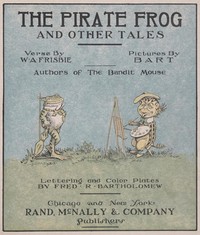
The Project Gutenberg edition notes that the Library of Congress page images appear out of order, and the sequence of poems may not match the original book. The text includes references to illustrations by Charles Lewis Bartholomew and Fred R. Bartholomew, with 'lettering and color plates' by the latter. The poems themselves contain visual cues—the pirate frog 'hoisting sail,' the Shanghai twins in 'helmet, club and star'—that likely complemented the pictures. Readers encountering this digital version should treat the poem order as provisional. The absence of page numbers means the narrative arc, if any, is uncertain; each poem stands alone, and the collection can be entered at any point.
Because the poems are short and self-contained, The Pirate Frog, and Other Tales works well for reading aloud or for early independent readers. The consistent rhyme scheme and repetitive structure make the verses predictable enough to support word recognition. The foreword’s winking admission that the book may 'appear to be devoid of truth' invites readers to enjoy the absurdity without worrying about literal lessons. Approach the collection as a series of comic vignettes rather than a unified story, and let the illustrations—where available—fill in the visual jokes the text only hints at.
Reader reflection
Record your reading impressions
A brief reflection can help important ideas stay with you longer.
Your progress
0
/
10
2
How did the book work for you overall?
3
Would you recommend this book to another reader?
4
How demanding did the text feel?
5
Was the book moving at the right speed?
6
How strong was your personal connection to the text?
7
How understandable was the text?
8
How useful were the ideas in this book?
9
Which lesson or insight stayed with you?
10