1

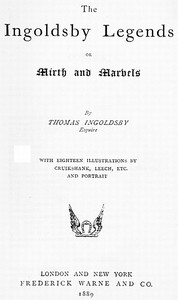
The Ingoldsby Legends; or, Mirth and Marvels — Story, Setting & Ideas
7
2
Project Gutenberg
2019
English wit and humor; Humorous poetry, English; English poetry -- 19th century; English fiction -- 19th century
Readers of public-domain and historical texts
Project Gutenberg digital edition
en
Edition facts
Words: 185,708
Reading time: 808 min
Text sections: 79
Source:
Project Gutenberg record #59236
Thomas Ingoldsby's collection of comic verse and prose tales blends supernatural folklore with irreverent humor, featuring recurring motifs of spectral apparitions, grotesque transformations, and abrupt shifts between eerie and absurd registers.
Editorial Edition Score
4.9/5
★★★★★
★★★★★
Calculated from edition completeness, EPUB availability, text structure and catalogue metadata. Not a user rating.
Edition quality
The Ingoldsby Legends opens with a table of contents that reads like a carnival billboard: spectres, hand of glory, witches' frolic, a jackdaw in Rheims. Thomas Ingoldsby (the pen name of Richard Harris Barham) arranges his tales in three series, mixing verse and prose without warning. The very first story, “The Spectre of Tappington,” establishes a pattern: a ghost story that keeps tripping over its own jokes. The narrator’s voice is chatty, prone to digression, and fond of mock-heroic similes. A knight sinking into the Rhine encounters a subaqueous court with a “Dory-faced page” and a “fat little Mer-man” saying grace. The supernatural is never allowed to stay solemn for long.
Structures of Accumulation and Interruption
The collection’s architecture is deliberately loose. Ingoldsby groups pieces under “First Series,” “Second Series,” and “Third Series,” but within each the genres shift unpredictably: a long verse legend, a prose anecdote, a dramatic fragment, a mock-play in five acts. The table of contents lists “ACT I.” through “ACT V.” as separate entries, yet the play is a parody. Several stories are framed as oral performances: “The Nurse’s Story,” “Mrs. Botherby’s Story,” “Mr. Barney Maguire’s Account.” These frames allow Ingoldsby to interrupt the narrative with asides, footnotes, and sudden changes in tone. The effect is cumulative rather than linear; the reader moves from one tale to the next without a unifying plot, only the persistent voice of the narrator.
Recurring Images: Water, Descent, and Transformation
Water appears repeatedly as a threshold to the marvellous. In “Sir Rupert the Fearless,” the knight plunges into the Rhine and sinks “forty fathom and more” to a crystal hall where fish have “very odd heads” and “very odd tails.” The descent is literal and comic: Rupert’s boots fill with water, and he worries about his dress. The same motif recurs in “The Spectre of Tappington,” where a ghostly hand emerges from a pond. Ingoldsby often pairs submersion with transformation: the knight is ogled by mermaids, the spectre is a revenant. These images are not symbolic but functional—they provide a stage for the narrator’s wordplay. The water is cold, the mud is sticky, and the punch lacks lemon.
Movement Between Scenes: The Jump-Cut and the Digression
Ingoldsby moves between settings with abrupt, almost cinematic cuts. In “Sir Rupert the Fearless,” the scene shifts from a moonlit riverbank to a submerged palace without transition: “Down, down, forty fathom and more from the brink, / Sir Rupert the Fearless continues to sink.” The reader is dropped into the new location mid-stanza. Elsewhere, the narrator breaks off to address the audience directly, as when he describes the fish and says “E’en the famed Mr. Myers / Would scarcely find buyers.” These digressions are the real engine of the comedy. The plot is often minimal—a knight follows a lady, a ghost haunts a house—but the narrator’s tangents, mock-apologies, and parenthetical remarks create a sense of constant motion.
Voice and Register: The Clerical Jester
Barham was a clergyman, and his narrator adopts a tone that is both learned and irreverent. He uses archaic diction (“quoth,” “boots it to tell”) alongside colloquial asides (“by jingo”). The verse is metrically loose, shifting from anapests to iambs within the same poem. In the excerpt, the narrator apologises for the knight’s dress: “If I could but have guess’d—what I sensibly feel— / Your politeness—I’d not have come en dishabille.” The French phrase is a punchline. This blend of registers—clerical, mock-heroic, slangy—is consistent across the collection. The narrator never settles into a single voice; he is always ready to undercut a solemn moment with a pun or a footnote.
Readers approaching The Ingoldsby Legends should expect a miscellany, not a novel. The pleasure lies in the local texture: the unexpected rhyme, the narrator’s digression, the sudden descent into a watery hall. The stories are best taken in short bursts, allowing the shifts in tone to register. Pay attention to the footnotes and the mock-scholarly apparatus; they are part of the joke.
Reader reflection
Take a moment to reflect on this book
Create a short personal record of your experience with this book.
Your progress
0
/
10
2
How much did you enjoy the reading experience?
3
How likely are you to recommend this book?
4
How easy was the book to follow?
5
Did any part of the book feel personally relevant?
6
How clear did the writing feel?
7
Did you gain anything practical from the text?
8
How well did it match your expectations?
9
What is the main idea you are taking away?
10