1

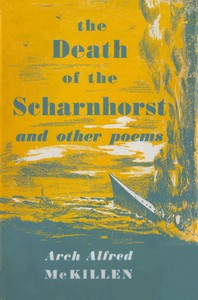
The Death of the Scharnhorst, and Other Poems — Edition Insights
5
1
Project Gutenberg
2021
Ships -- Poetry; Scharnhorst (Battleship) -- Poetry; World War, 1939-1945 -- Poetry
Readers of public-domain and historical texts
Project Gutenberg digital edition
en
Edition facts
Words: 13,324
Reading time: 58 min
Text sections: 3
Source:
Project Gutenberg record #64594
Arch Alfred McKillen's 1952 collection of poems moves from intimate scenes of birds and lads to warfronts in Spain, the Pacific, and Europe, using recurring images of sleep, death, and the sea to structure a meditation on loss across multiple theaters of conflict.
Editorial Edition Score
4.5/5
★★★★★
★★★★★
Calculated from edition completeness, EPUB availability, text structure and catalogue metadata. Not a user rating.
Edition quality
The collection opens with a quiet domestic scene—a bird chirping, a lad walking to work—and immediately asks what fates await the three figures. This small, personal frame recurs throughout the book, often juxtaposed with large-scale violence. McKillen moves between intimate lyrics and war reportage, using the same plain diction for a lover's glance and a burial at sea. The poems are short, many under twenty lines, and favor direct address: the dead are spoken to, the living are commanded to avenge. Repetition of key words—sleep, heart, sea, lad—creates a rhythmic continuity across disparate subjects, from the Spanish Civil War to the sinking of the Scharnhorst.
The Bird, the Lad, and the Soldier
The title poem of the opening section introduces a pattern of three figures—bird, lad, speaker—that later transforms into soldier, comrade, enemy. In “The War in Spain,” the murdered lads “who might have laughed awhile” echo the earlier lad’s leather heels. The speaker often positions himself as a witness, not a combatant: he hears, watches, remembers. This observer role is consistent even in battle poems like “The Crossing of the Rhine,” where the speaker drinks and toasts rather than fights. The collection’s structure relies on these recurring character types—the young man, the dead sailor, the deck-ape—to link personal loss to collective catastrophe.
Sleep, Death, and the Sea
Sleep is the most persistent image, appearing in nearly every poem. It begins as literal rest (“I lay in bed awakened”) and becomes a metaphor for death: “He sleeps the silence of unspoken love” in “Sailor Boy,” and the dead sailor in “The Ballad of the Dead Sailor” yearns for companions but is denied breath. The sea is both setting and grave: the Squalus dirge, the burial of the deck-ape, the Scharnhorst’s sinking. McKillen often blurs the boundary between sleep and death, as in “The Sentry,” where the soldier who falls asleep is shot, and the wind hums a lullaby. This ambiguity gives the war poems a haunting, unresolved quality.
Movement Between Theaters
The poems shift rapidly across geography and time: Spain, Pearl Harbor, Wake Island, the Rhine, the Pacific. This movement is not chronological but associative. “The Litany of Pearl Harbor” (dated December 7, 1942) is followed by “We Were Waiting That Morning for Colors,” then “The Motor Launch Crew.” Europe and the Pacific alternate. The effect is a global war seen through a single consciousness. McKillen uses place names as shorthand for horror: Bataan, Corregidor, Guam. The poem “Avenge” catalogs massacres in Poland, Guam, and the Philippines in one breath, collapsing distance into moral outrage. The structure mirrors a newsreel or a soldier’s memory—discontinuous but cumulative.
Voice and Address
McKillen frequently uses direct address: to the dead (“Smile a little, lad”), to God (“Great sword of God”), to the reader (“Look well at each other”). This creates a sense of urgency and intimacy. The poems often end with a command or a question: “Annihilate! Annihilate! / We’ll do it if You won’t!” or “Must I still call out for companions?” The voice is sometimes collective (“We were waiting that morning for colors”), sometimes solitary (“I have found no other one / To stand and watch with me”). This alternation between we and I mirrors the tension between shared experience and individual grief. The final poem, “Bury Him,” returns to the imperative, closing the collection with a directive that echoes the opening’s speculative tone.
McKillen’s poems reward attention to small structural echoes: the bird that opens the book, the sea that closes it; the lad who walks to work, the soldier who never returns. Readers may find it useful to track the recurrence of sleep and waking, or to note how the same images—heart, sea, smile—shift meaning between personal and martial contexts. The collection does not offer a linear narrative but a mosaic of moments, held together by a consistent, unadorned voice.
Reader reflection
What was your reading experience?
Capture what you thought, learned, and would like to remember.
Your progress
0
/
10
2
Did this book hold your interest?
3
Would you encourage someone else to read it?
4
How easy was the book to follow?
5
Did any part of the book stay with you emotionally?
6
Was the book what you thought it would be?
7
Do you expect to return to this book?
8
Would you like to discuss this book with someone?
9
Which lesson or insight stayed with you?
10