1

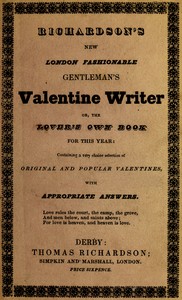
Richardson's New London fashionable gentleman's valentine writer, or, the lover's own book for this year — Key Ideas to Explore
7
3
Project Gutenberg
2023
English poetry -- 19th century; Love poetry, English; Valentines; Courtship -- Poetry
Readers of public-domain and historical texts
Project Gutenberg digital edition
en
Edition facts
Words: 8,320
Reading time: 37 min
Text sections: 5
Source:
Project Gutenberg record #70588
This 19th-century valentine writer offers paired verses from tradesmen and servants, with compliant and rejecting answers, revealing courtship through the lens of occupation and social station.
Editorial Edition Score
4.6/5
★★★★★
★★★★★
Calculated from edition completeness, EPUB availability, text structure and catalogue metadata. Not a user rating.
Edition quality
This valentine writer, published by Thomas Richardson in Derby, presents a series of paired poems: a gentleman's or tradesman's address followed by a lady's answer, either compliant or rejecting. The verses are structured around the suitor's occupation—hatter, tanner, cobbler, groom—and the replies often playfully turn the trade's tools and materials into metaphors for love or refusal. The opening poem sets a pattern of internal debate about marriage, resolved by the declaration that the chosen lady will be the Valentine. The book's subtitle promises 'original and popular valentines, with appropriate answers,' and the excerpts deliver exactly that: a catalog of courtship scenarios tailored to specific social roles.
Occupational Metaphors as Courtship Strategy
The suitors in this collection do not rely on generic compliments; they ground their declarations in the details of their trades. The hatter compares his beloved's skin to 'beaver soft and fine' and her hair to 'down' suitable for a hat, while the cobbler sees her teeth as 'pegs' and her wit as his 'knife.' The tanner assures his Valentine he will not 'tan the hide of you,' turning a threat into a promise. These occupational metaphors serve a dual purpose: they display the suitor's skill and identity, and they create a shared language that the lady can engage with in her reply. The groom's appeal to the cook, for instance, uses kitchen imagery—'roast or boil,' 'puddings, pies, or tarts'—to which the cook responds by dismissing his 'cupboard love.' This pattern suggests that the book's intended audience valued wit and specificity over vague romantic sentiment.
The Pragmatic Rejection: Refusals Grounded in Practicality
Several answers of rejection in this collection are notable for their practical, even financial, reasoning rather than personal dislike. The young man 'nearly out of his time' is told to wait until he is established in business, as 'so many now fail in their toil.' The servant who would resign his place is warned: 'If you gave up your ways and means, / How could you keep a Valentine?' The brewer's answer declines because the lady does not understand his trade—'I your barley cannot dry, / Nor yet your blind horse supply.' These refusals are not cruel; they are sensible assessments of a suitor's prospects. They reflect a social reality where marriage was tied to economic stability, and the valentine verses serve as a vehicle for negotiating that reality. The rejected suitor is not mocked but instructed, and the lady's voice is given authority to set conditions.
Recurring Structural Patterns: The Paired Verse as Dialogue
Every excerpt in this collection follows a strict dialogic structure: a suitor's verse is immediately followed by an answer, either of compliance or rejection. The suitor's poem typically opens with a declaration of love or a description of the speaker's state, then makes a direct request. The answer mirrors the suitor's form, often echoing key phrases or images. In the cobbler's exchange, the lady's reply parodies his extended metaphor, substituting her own beloved 'Tommy O'Twizzle' for the cobbler. The hatter's answer dismisses him as a 'saucy knave' and tells him to 'mind your trade.' This symmetry suggests that the book was designed for performance or recitation, where both parties could read their parts. The consistent pairing also implies a social script: courtship is a game with known moves, and the valentine writer provides the lines.
Social Range and the Implied Reader
The valentines in this collection cover a broad social spectrum, from gentlemen to servants, hatters, tanners, cobblers, grooms, and brewers. The title addresses the 'fashionable gentleman,' but the contents include verses for a 'servant to his favourite lass' and a 'young man nearly out of his time.' This range suggests that the book was marketed to a readership that included both the aspiring middle class and the working class, or at least that it aimed to provide verses suitable for various stations. The answers, too, vary in tone: the lady's compliance is often gracious, while rejection can be sharp or humorous. The book does not elevate one class over another; instead, it offers a toolkit for anyone seeking to express love or refusal within the conventions of the valentine. The reader is implicitly invited to select the poem that fits their own circumstances, making the book a practical guide rather than a literary anthology.
Readers approaching this valentine writer should attend to the interplay between the suitor's trade and the lady's response, as the poems reward attention to occupational detail. The paired structure invites reading aloud, and the variety of answers—from warm acceptance to witty refusal—offers a spectrum of social negotiation. The book is best understood as a period artifact of courtship rituals, where love is expressed through the language of work and practical concerns temper romantic declarations.
Reader reflection
Record your reading impressions
A brief reflection can help important ideas stay with you longer.
Your progress
0
/
10
2
How did the book work for you overall?
3
Is this a title you would suggest to others?
4
Did the language feel accessible?
5
Would you start a conversation about this book?
6
Was the book what you thought it would be?
7
Which part made the strongest impression?
8
What was its emotional impact?
9
What changed or sharpened your thinking?
10