1

Down-adown-derry — A Reader’s Guide
4
1
Project Gutenberg
2010
Children's poetry, English; Conduct of life -- Juvenile poetry; Children -- Conduct of life -- Juvenile poetry; Fairy poetry, English
Readers of public-domain and historical texts
Project Gutenberg digital edition
en
Edition facts
Words: 15,740
Reading time: 69 min
Text sections: 4
Source:
Project Gutenberg record #32091
Walter de la Mare's 1922 fairy poem collection uses irregular meter, refrains, and precise natural imagery to create eerie, playful encounters with fairies, witches, and dwarfs, often hinging on laughter, fear, or a child's perspective.
Editorial Edition Score
4.5/5
★★★★★
★★★★★
Calculated from edition completeness, EPUB availability, text structure and catalogue metadata. Not a user rating.
Edition quality
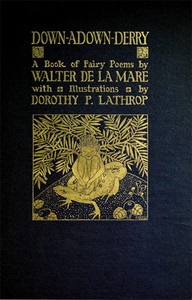
Walter de la Mare's Down-adown-derry (1922) opens with fairies dancing at dawn, their singing 'soft as the moon on wavering wing'—a simile that blends sound and light. The collection's 53 poems, illustrated by Dorothy P. Lathrop, are grouped under 'Fairies,' 'Witches and Witchcraft,' and 'The World of Dream,' but the catalog subjects 'Children—Conduct of life' find little direct echo in the excerpts. Instead, the poems dwell on ambiguous encounters: a dwarf who rewards laughter with fruit, a girl who must not laugh, and mermaids who lure a farmer to a feast 'off plates of gold.'
Meter, Refrain, and the Unstable Voice
De la Mare varies line length and rhyme scheme unpredictably, often within a single poem. 'The Fairies Dancing' shifts from iambic tetrameter to a trimeter refrain: 'Soft as the moon on wavering wing.' 'A-Tishoo' uses a nursery-rhyme cadence ('Sneeze, Pretty, sneeze, / Dainty'), while 'The Dwarf' builds a repeating refrain that changes each stanza: 'To keep from laughing at all, at all.' The effect is a voice that sounds childlike but slips into menace or absurdity. In 'Longlegs,' a yell 'rang—rang through / The clear green gloom,' and the echo returns 'a thin "Coo-ee!"'—a sound that seems to mock the caller. The poems resist a single tone, moving from lullaby to threat within a few lines.
Natural Details as Thresholds
De la Mare's settings are precise but liminal: 'early hills,' 'a wood of oak and may,' 'Barberry Wood,' 'a rain-sweet glade.' These are not generic fairylands but named, sensory places. In 'The Fairies Dancing,' the speaker watches from behind a hawthorn-bush as dawn 'flushed' the fairies' flaxen hair; the poem ends with 'Urdon's copper weathercock' and 'the towers and groves of Arroar'—place-names that sound invented yet concrete. 'The Dwarf' takes place in a house 'in Barberry Wood,' with a pumpkin thrown 'over the wall.' Such details ground the supernatural in a recognizable English countryside, making the intrusion of magic feel both intimate and strange.
Laughter, Tears, and the Rules of Engagement
Several poems hinge on a character's emotional response. In 'The Dwarf,' Jane must not laugh at the dwarf's appearance, but when she finally does, he rewards her with cherries and a 'gladsome duet.' The poem ends with a riddle: 'who can draw tears from a well?'—suggesting that laughter and crying are linked. In 'A-Tishoo,' a sneeze is the only defense against elves: 'Sneeze, Light-of-Seven-Bright-Candles, / See they're tippeting at the door.' The rules are arbitrary and unexplained. 'Off the Ground' describes a farmer who dances with mermaids and vanishes; his friends pay his debts but cannot retrieve him. The poems present fairy encounters as governed by opaque logic, where a sneeze, a laugh, or a dance can determine one's fate.
The excerpts offer no moral or conduct lessons; instead, they present a world where fairies are neither benign nor malevolent, but capricious. Readers should attend to de la Mare's sound patterns—the refrains, the sudden shifts in rhythm—and to the way natural objects (berries, honey, pumpkins) become tokens of exchange. The poems reward rereading for their compressed imagery and ambiguous endings, which often leave the human character transformed, lost, or simply laughing.
Reader reflection
Take a moment to reflect on this book
Create a short personal record of your experience with this book.
Your progress
0
/
10
2
Was reading this book enjoyable?
3
Would you recommend this book to another reader?
4
What was the reading difficulty like?
5
How valuable was this book for your own interests?
6
How strong was your personal connection to the text?
7
Do you expect to return to this book?
8
How would you describe its reading pace?
9
Which lesson or insight stayed with you?
10