1

Christmas in Poetry: Carols and Poems — Inside the Classic
8
3
Project Gutenberg
2013
Christmas poetry
Readers of public-domain and historical texts
Project Gutenberg digital edition
en
Edition facts
Words: 9,525
Reading time: 42 min
Text sections: 2
Source:
Project Gutenberg record #44524
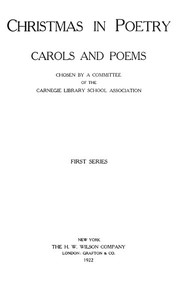
This collection of 44 Christmas poems and carols, compiled by the Carnegie Library School Association, spans medieval to early 20th-century works. The excerpts reveal a focus on narrative voices—shepherds, kings, and even a reluctant witness—and recurring motifs of winter, gifts, and humble settings. The arrangement juxtaposes familiar hymns with lesser-known pieces, offering varied perspectives on the Nativity.
The collection opens with an old English carol that blesses the household—"God bless the master of this house, / The mistress also"—establishing a tone of communal celebration. Immediately following, William Morris's "From Far Away" shifts to a narrative frame: minstrels arrive to tell "great tidings, strange and true," with the refrain "The snow in the street, and the wind on the door" grounding the supernatural in wintry reality. This pairing sets up a tension between domestic comfort and the disruptive news of the Nativity, a thread that runs through many of the poems.
Voices of the Nativity: Shepherds, Kings, and a Reluctant Witness
The excerpts repeatedly foreground characters who witness the Nativity from different angles. In "The Shepherd Who Stayed" by Theodosia Garrison, a shepherd explicitly chooses not to follow the angelic summons: "I only know I stayed." His voice is defensive yet resolute, emphasizing duty over revelation. This contrasts with the shepherds in William Canton's "Carol," who watch "herds" and find a "spotless lambkin from the heavenly hill." The collection also includes "We Three Kings" by J. H. Hopkins Jr., where the Magi speak of their journey, and Christina Rossetti's "Christmas Carol" ("In the bleak mid-winter"), where the speaker imagines what to give—"If I were a shepherd I would bring a lamb, / If I were a Wise Man, I would do my part." These varied perspectives create a chorus of responses to the same event, from awe to quiet refusal.
Winter Landscapes and the Material World
Many poems anchor the Nativity in precise, often harsh winter imagery. Rossetti's "bleak mid-winter" with "Frosty wind made moan" and "Snow had fallen, snow on snow" is echoed in "Good King Wenceslas" ("the snow lay round about, / Deep, and crisp, and even") and the old English carol's "snow in the street." Yet the collection also includes warmer domestic scenes: Robert Herrick's "A Child's Present to His Child-Saviour" offers a "whistle new / Made of a clean straight oaten reed" and a flower, while the "Wassail Song" and "Wassailer's Song" invoke feasting and drinking. The juxtaposition of cold outdoors and cozy interiors—"Every hearth is aflame" (Josiah Gilbert Holland)—reinforces the theme of light in darkness, but the poems rarely sentimentalize poverty; instead, they note the "stable-place" and the "moneyless" child.
Repetition and Refrain as Structural Devices
The carols and poems frequently employ refrains that anchor the reader in a recurring image or phrase. In "From Far Away," the line "The snow in the street, and the wind on the door" appears after each stanza, creating a rhythmic insistence on the setting. Similarly, "A Christmas Carol" by Josiah Gilbert Holland repeats "the star rains its fire while the Beautiful sing" as a chorus. The old English carol's blessing formula—"God bless the master… / The mistress also"—is a simpler, litany-like repetition. These refrains not only aid memorization (a practical function of carols) but also emphasize key themes: the persistent cold, the celestial light, and the communal wish for goodwill. Readers may notice how the refrains shift in meaning as the poems progress, from invitation to declaration.
Gifts, Offerings, and the Problem of Poverty
A recurring concern across the excerpts is what to give the Christ child, especially when the giver is poor. Herrick's child offers a whistle and a flower, acknowledging "poor thou art, and known to be / Even as moneyless as He." Rossetti's speaker concludes, "What can I give Him, / Poor as I am?… Yet what I can I give Him, / Give my heart." The "Carol of the Russian Children" (a folk song) and the "Child's Present" both frame giving as an act of love rather than material value. Even the shepherd who stays offers his faithfulness. This motif of humble gifts contrasts with the Magi's gold, frankincense, and myrrh (mentioned in "We Three Kings"), creating a spectrum of offerings that invites readers to consider what constitutes a worthy gift.
Because the excerpts represent only a portion of the 44 poems, readers should expect the full collection to include additional voices and variations on these themes. The compiler's arrangement—mixing familiar carols with lesser-known works—encourages comparison across centuries and traditions. Pay attention to how each poem handles the tension between the miraculous and the mundane, and note the recurring figures of shepherds, kings, and animals. The book rewards a slow, sequential reading, allowing the refrains and images to accumulate meaning.
Reader reflection
Before you leave, reflect on the book
Use these questions to collect your thoughts before moving on.
Your progress
0
/
10
2
What was your overall reaction to the book?
3
How likely are you to recommend this book?
4
How easy was the book to follow?
5
How understandable was the text?
6
How did the reading compare with what you expected?
7
Which part made the strongest impression?
8
How did the pace of the book feel?
9
What changed or sharpened your thinking?
10