1

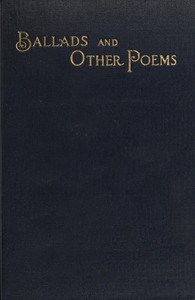
Ballads and Other Poems Fourth Edition, Revised — Reading Companion
8
1
Project Gutenberg
2022
American poetry -- 19th century; United States -- History -- Revolution, 1775-1783 -- Poetry
Readers of public-domain and historical texts
Project Gutenberg digital edition
en
Edition facts
Words: 75,331
Reading time: 328 min
Text sections: 21
Source:
Project Gutenberg record #67152
George Lansing Raymond's 1916 collection combines Revolutionary War ballads with lyrical and dramatic poems, including a verse drama about Haydn's love and art. The catalog subjects (American poetry, Revolution) only partially capture the work's range.
George Lansing Raymond’s Ballads and Other Poems, in its fourth revised edition (1916), opens with a series of narrative poems on the American Revolution, but the table of contents reveals a far broader scope. The volume is divided into sections: “Ballads of the Revolution,” “Miscellaneous,” “Dramatic,” “Sketches in Song,” and “Patriotic.” The catalog subjects—American poetry of the 19th century and the Revolutionary War—accurately describe the first and last sections, but the middle portions include love lyrics, philosophical meditations, and a verse drama about the composer Joseph Haydn. This editorial note examines how the catalog subjects relate to the actual contents, highlighting the work’s uneven generic identity.
Revolutionary Ballads as Historical Argument
The “Ballads of the Revolution” section is the most coherent and historically focused. Raymond uses a ballad form to narrate key events, from the Stamp Act crisis (“Our First Break with the British”) to Ethan Allen’s exploits. The poems are heavily annotated with marginal citations—Franklin, Otis, and others are quoted directly within the verse. For instance, the line “The colonies’ hope is union” is attributed to Franklin, and “Freedom is a birthright” to James Otis. This technique turns the ballads into a kind of versified history lesson, blending narrative with documentary evidence. The catalog subject “United States – History – Revolution, 1775-1783 – Poetry” fits this section precisely, but it does not prepare a reader for the abrupt shift in tone and subject that follows.
The Haydn Drama: Love, Vows, and Sacrifice
The longest single piece in the volume is the dramatic poem “Haydn,” which occupies pages 115–158 (based on the table of contents). The excerpts reveal a first-person narrative by a woman named Pauline, who recounts her love for the composer Haydn, her decision to enter a convent, and her urging him to marry another woman, Doretta. The language is sentimental and introspective: “My soul must know if it should praise or plead.” Pauline describes a pact with Haydn to meet after a year, where he will bring fresh flowers if happy, wilted stems if not. This section has no connection to the catalog subjects; it is a fictionalized romance set in 18th-century Europe, not an American poem. Readers expecting only Revolutionary verse will find a different mode entirely.
Miscellaneous and Patriotic: A Mixed Bag
The “Miscellaneous” and “Patriotic” sections further complicate the catalog classification. “Miscellaneous” includes poems like “A Song on Singing,” “The Music of Life,” and “Caged”—lyrical and abstract pieces with no historical referent. “Patriotic” returns to national themes with titles like “America, Our Home” and “Hail the Flag,” but these are general anthems, not tied to specific events. The catalog subject “American poetry – 19th century” is broad enough to cover all these, but it obscures the volume’s internal diversity. The 1916 edition also includes “Sketches in Song,” a subsection with poems such as “A Fish Story” and “Unveiling the Monument,” which mix humor and occasional verse. The catalog subjects, while not wrong, give a misleading impression of uniformity.
Readers approaching this volume through its catalog subjects should be prepared for a collection that is less a unified work than a compendium of Raymond’s poetic output across several decades. The Revolutionary ballads are the most historically anchored, but the dramatic and lyrical pieces reveal a poet interested in European culture, personal emotion, and philosophical reflection. The fourth edition’s revisions are not detailed in the excerpts, but the range of material suggests that Raymond’s reputation as a poet of the Revolution is only part of his literary identity.
Reader reflection
What was your reading experience?
Capture what you thought, learned, and would like to remember.
Your progress
0
/
10
2
How much did you enjoy the reading experience?
3
Would you recommend this book to another reader?
4
How demanding did the text feel?
5
Did the book deliver what you hoped for?
6
How did the pace of the book feel?
7
Did it raise ideas you would like to talk about?
8
What was the strongest part of the book?
9
What did this book teach you most?
10