1

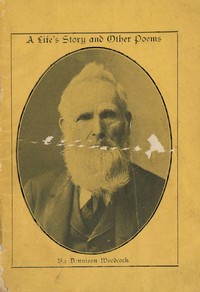
A Life's Story, In Poetry. Other Poems — Text and Context
8
3
Project Gutenberg
2021
American poetry -- 20th century
Readers of public-domain and historical texts
Project Gutenberg digital edition
en
Edition facts
Words: 8,071
Reading time: 36 min
Text sections: 13
Source:
Project Gutenberg record #66080
Dennison Woodcock's 1908 collection of poems, written at age 91, blends autobiography with moral verse. The title poem traces his life from childhood to old age, while other poems address temperance, women's suffrage, and cautionary tales. The work's structure moves between personal recollection and didactic commentary.
Dennison Woodcock's A Life's Story, In Poetry. Other Poems, published in 1908 when the author was ninety-one, is a collection that moves between personal recollection and moral instruction. The title poem traces Woodcock's life from childhood to old age, while shorter poems address temperance, women's suffrage, and cautionary tales. The work's structure alternates between narrative autobiography and direct address, creating a rhythm of reflection and exhortation.
The Autobiographical Frame
The title poem, A Life's Story, is the collection's longest and most structurally ambitious piece. It begins with a child's naive questions about nature—why the wind blows, how a mill works—and moves through apprenticeship, westward travel, and old age. Woodcock uses concrete details: the "lofty pines" he blamed for the wind, the "limber stick" he fashioned into a saw, the "Clinton's Ditch" canal journey. These images ground the poem in specific experience, even as the meter and rhyme remain regular. The poem's episodic structure mirrors the accumulation of a life, with each stanza marking a new scene or insight.
Recurring Images of Entrapment
Several poems share a preoccupation with being stuck or trapped. In WRIGHTS CAUTION TO BOYS, or THE SILLY FLY, a fly lands on sticky paper and cannot escape, becoming a metaphor for addiction: "He struggled hard to get away, / Found that he was doomed to stay." The poem then shifts to a young smoker who, like the fly, becomes a "lifelong slave unto his pipe." THE RUINED HOME depicts a family trapped by alcoholism, with the husband "staggering in" and the wife struck down. Even in A Life's Story, the child's confusion about the mill's mechanism suggests a mind caught between observation and understanding.
Movement Between Scenes
Woodcock's poems often shift abruptly from one setting to another, creating a sense of movement that mirrors the picaresque tradition. In A Life's Story, the speaker moves from the family farm to Boston, then west via canal boat, with each stanza introducing a new location or problem. The shorter poems also change scenes: THE RUINED HOME opens on a happy domestic interior—"Music in Adjoining room / So grateful to the ear"—before the drunken husband arrives and the home disintegrates. This technique of juxtaposition heightens the moral contrast between order and chaos.
Direct Address and Moral Purpose
Several poems adopt a direct, hortatory tone. IN FAVOR of WOMAN'S SUFFRAGE opens with a historical analogy to the American Revolution: "Our fathers thought it was a cause / Well worth their undertaking." The poem then addresses the reader directly, accusing men of hypocrisy. WRIGHTS CAUTION TO BOYS uses the second person to warn against smoking. This rhetorical strategy positions the reader as a listener being instructed, a common feature of nineteenth-century didactic verse. The poems' moral arguments are explicit, leaving little room for ambiguity.
Woodcock's collection rewards attention to its structural choices: the way autobiography gives way to sermon, the recurrence of entrapment imagery, and the abrupt shifts between domestic peace and ruin. Readers interested in early twentieth-century American verse, temperance literature, or the autobiographical impulse in poetry will find here a distinctive voice, one that blends personal history with public exhortation.
Reader reflection
Before you leave, reflect on the book
Use these questions to collect your thoughts before moving on.
Your progress
0
/
10
2
What was your overall reaction to the book?
3
Would you pass this book on to a friend?
4
What was the reading difficulty like?
5
How did the pace of the book feel?
6
Did you gain anything practical from the text?
7
How strong was your personal connection to the text?
8
How strongly did the book affect you emotionally?
9
What changed or sharpened your thinking?
10